Download
1 / 8
80 likes | 223 Vues
This text explores the equilibrium composition of aerosol particles, specifically focusing on the formation of NH4NO3 in an air parcel at T = 300 K and 30% relative humidity, containing 20 ppb of HNO3 and NH3. It discusses the concepts of deliquescence and efflorescence in single-component systems, with a special emphasis on sodium chloride (NaCl). Additionally, it touches on the Gibbs Free Energy of deliquescence and the influence of relative humidity on water activity in atmospheric particles. The study elucidates the conditions under which solid particles form and their mass concentrations.

E N D
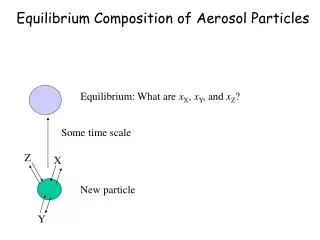
Equilibrium Composition of Aerosol Particles Equilibrium: What are xX, xY, and xZ? Some time scale Z X New particle Y
pB pB pA pA 0 0 1 1 xA xA Ideal and Non-Ideal Behavoir of Solutions
Question Consider an air parcel at T = 300 K and 30% RH with 20 ppb HNO3 and 20 ppb NH3 in the gas-phase. Will NH4NO3 particles form? If so, what is the NH4NO3 aerosol mass concentration if no other particulate matter exists? Assume only solid particles (no aqueous solutions).
Deliquescence – Efflorescence of a Single Component System (NaCl) efflorescence deliquescence Tang, JGR-D 1997
Gsolution Solid favored Gsolid Solution favored DRH Free Energy of Deliquescence - Efflorescence Gibbs Free Energy RH
Evolution of Water Activity in Atmospheric Particle Often requires knowledge of RH-histroy RH>80% RH<40% RH=70% RH=80% Ocean Land
Deliquesence-Efflorescence of Complex Compositions Lightstone, et al. JPC 2000 Schlenker, et al. JPC 2005
Kelvin Effect: Physical Cartoon Equilibrium vapor pressure is higher over a curved surface than a flat one. Important for nucleation of new particles, lifetime of small droplets.