
SlideServe
Menu
Préférences
© SlideServe · v2026

FDR’s New Deal: Transforming America During the Great Depression

taya avatar
2 diapositives · 196 Views · Aug 10, 2014

In 1933, when FDR took office, millions of Americans were unemployed. The Civilian Conservation Corps (CCC) provided jobs for young men, hiring them to work on environmental projects like planting trees and building parks. The Works Progress Administration (WPA) further aided the jobless, creating infrastructure and employing artists to celebrate American life. The National Industrial Recovery Act (NIRA) sought to stabilize industries and prices, while the Agricultural Adjustment Act (AAA) addressed farm surpluses. Initiatives like the Tennessee Valley Authority (TVA) aimed to revitalize struggling regions.
FDR’s New Deal: Transforming America During the Great Depression - slide 1
01 / 2FDR’s New Deal: Transforming America During the Great Depression
1 / 17

Télécharger la présentation

FDR’s New Deal: Transforming America During the Great Depression
Une image / un lien ci-dessous est fourni (tel quel) pour télécharger la présentation

Politique de téléchargement : le contenu du site vous est fourni TEL QUEL pour votre information et votre usage personnel ; il ne peut être vendu, concédé sous licence ni partagé sur d’autres sites sans l’accord de son auteur.Le contenu vous est fourni TEL QUEL, pour votre information et votre usage personnel uniquement. Téléchargez la présentation en cliquant sur ce lien. Lors du téléchargement, si vous ne parvenez pas à télécharger une présentation, l’éditeur a peut-être supprimé le fichier de son serveur.Pendant le téléchargement, si vous ne parvenez pas à obtenir une présentation, le fichier a peut-être été supprimé par l’éditeur.

F I N

Plus de contenu associé

Transcription de la présentation
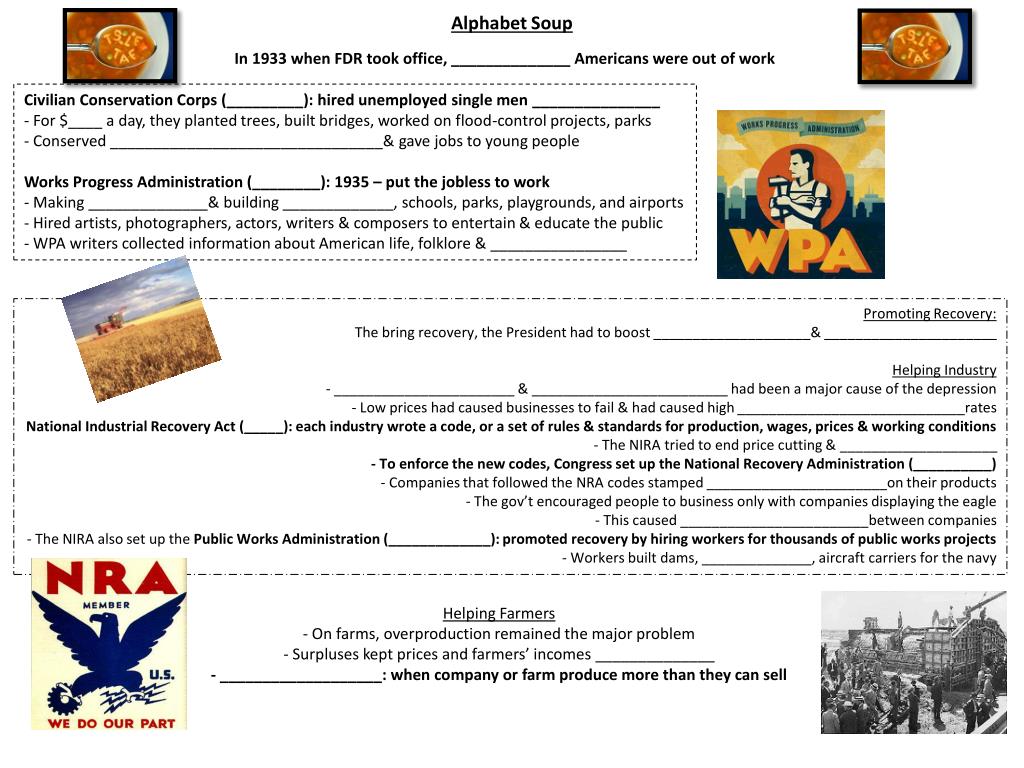
  1. In 1933 when FDR took office, ______________ Americans were out of work • Civilian Conservation Corps (_________): hired unemployed single men _______________ • - For $____ a day, they planted trees, built bridges, worked on flood-control projects, parks • - Conserved ________________________________& gave jobs to young people • Works Progress Administration (________): 1935 – put the jobless to work • - Making ______________& building _____________, schools, parks, playgrounds, and airports • - Hired artists, photographers, actors, writers & composers to entertain & educate the public • - WPA writers collected information about American life, folklore & ________________ Alphabet Soup • Promoting Recovery: • The bring recovery, the President had to boost ____________________& ______________________ • Helping Industry • - _______________________ & _________________________ had been a major cause of the depression • - Low prices had caused businesses to fail & had caused high _____________________________rates • National Industrial Recovery Act (_____): each industry wrote a code, or a set of rules & standards for production, wages, prices & working conditions • - The NIRA tried to end price cutting & ____________________ • - To enforce the new codes, Congress set up the National Recovery Administration (__________) • - Companies that followed the NRA codes stamped _______________________on their products • - The gov’t encouraged people to business only with companies displaying the eagle • - This caused ________________________between companies • - The NIRA also set up the Public Works Administration (_____________): promoted recovery by hiring workers for thousands of public works projects • - Workers built dams, ______________, aircraft carriers for the navy • Helping Farmers • - On farms, overproduction remained the major problem • - Surpluses kept prices and farmers’ incomes ______________ • - ___________________: when company or farm produce more than they can sell

  2. More help for farmers… • Agricultural Adjustment Act (___________): gov’t paid farmers NOT to grow certain crops • Roosevelt hoped that with smaller harvests, laws of _______________________would cause prices to rise • By limiting the amount of “available” options, people would pay more lump sums for ________________________ • The gov’t paid for farmers to plow surplus crops under the soil & destroy surplus cows & pigs • People thought this was crazy when people in cities were ___________________ • The plan was necessary to help farmers ______________________& keep them growing food • Rural Electrification Administration (_____): help people in rural areas get the same electrical service as people in urban areas • - Provided $$ to extend electric lines to ______________areas • - # of farms with electricity rose from ______________% • - Electricity helped to save many farms from ruin • *___________________– dairy farmers could keep milk & eggs longer • Preventing Another Depression • - During the Hundred Days, Congress passed laws regulating the stock market & banking system • _________________________Act: end the risky buying/ selling of stocks in the hope of making a quick profit • Federal Deposit Insurance Corporation (__________): Insured savings accounts in banks approved by the gov’t – if a bank insured by the FDIC failed, the gov’t would make sure depositors received their $$ • Tennessee Valley Authority (__________): set out to remake the Tennessee River Valley – a vast region that had suffered from terrible floods that had caused ________ of the areas farms & families to fail • -_____dams were built in ______ states – also produced cheap electric power • - The TVA deepened river channels for shipping • - Planted new forests to conserve __________ • - Developed new _______________to improve farmland • - Set up ______________& health centers • - Result: transformed a region of desperation & poverty into a prosperous & productive area