Advanced Beamwidth Profiling Techniques for TRUS Devices in Prostate Imaging
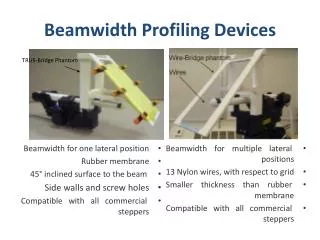
This study focuses on beamwidth profiling devices for Transrectal Ultrasound (TRUS) applications, detailing the design and functional compatibility of the TRUS-Bridge Phantom. Key features include the use of rubber membranes, inclined surfaces, side walls, and screw holes for optimal imaging. The experimental setup utilizes the SonixTouch ultrasound machine to acquire and segment images at various depths. Results reveal the behavior of the ultrasound beam profile, including the focal zone and side lobe effects. Findings offer insights into needle localization and intensity profiles, essential for improving prostate cancer treatments.

Advanced Beamwidth Profiling Techniques for TRUS Devices in Prostate Imaging
E N D
Presentation Transcript
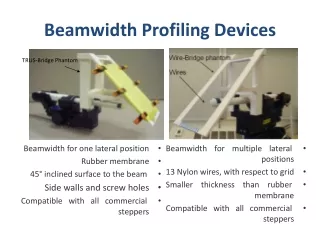
Beamwidth Profiling Devices TRUS-Bridge Phantom • Beamwidth for one lateral position • Rubber membrane • 45° inclined surface to the beam • Side walls and screw holes • Compatible with all commercial steppers • Beamwidth for multiple lateral positions • 13 Nylon wires, with respect to grid • Smaller thickness than rubber membrane • Compatible with all commercial steppers
Beam Profiling Experimental Setup • TRUS images acquired for every depth and manually segmented • Experimented with the SonixTouch US machine • US beam profile is generated
TRUS Beam Profile R=Rectum PZ= Peripheral Zone U=Urethra TZ=Transitional Zone TZ U PZ R • Section-thickness starts diverging after the focal zone • Focal zone is closely located to the US transducer Figure: http://www.keyholeurology.co.uk/prostatecancer.html
Needle Localization Measurement Needle localization of main beam Needle Localization of main and side lobe beams • Compare the observed reflections to a reference point • Ref. point=first inserted needle reflection on a column
Needle Insertion Experimental Setup • Brachytherapy stepper and grid template are in submerged distilled water-glycerol bath • Experimented with the SonixTouch US machine • For each needle, the stepper position where the first reflection appears is recorded
Needle Localization Offset • Average and std. of N(j)-N(1) for gain=0%, dynamic range= 15, 50 and 100 dB, and power=0,-4, and -7 • Beam converges to a point and diverges right after • Beam has a focal zone
Needle Localization Offset • Average and std. of N(j)-N(1) for gain=0%, dynamic range= 15, 50 and 100 dB, and power=0,-4, and -7 • Beam converges to a point and diverges right after • Beam has a focal zone
Side Lobe Effects Intensity profile of main beam Intensity profile of main and side lobe beams • Group of thin, parallel, low intensity bands on both sides corresponding to side lobes