Download
1 / 14
140 likes | 244 Vues
This lesson explores the intricate process of protein synthesis, highlighting the roles of DNA, RNA, and various types of nucleotides. It details the structure of DNA and RNA, the significance of codons and anticodons, and how genes translate into functional proteins. Students will learn how proteins, constructed from amino acids, influence cellular functions and inheritance patterns. The lesson incorporates visual animations and links to online resources for deeper understanding, making complex genetics accessible to all.

E N D
Protein Synthesis Modern Molecular Genetics University of Maryland College Park LFSC 620
Lesson Objectives • DNA structure • Nucleotide • Nitrogen bases • Proteins and Cell structure • mRNA • tRNA • The DNA-Protein connection
DNA (Deoxyribonucleic acid) • Structure • Made up of subunits called nucleotides • 2 strands of nucleotides • Nucleotides contain • Deoxyribose sugar • Phosphate group • Nitrogen bases • Adenine (A) • Guanine (G) • Cytosine (C) • Thymine (T) http://nobelprize.org/educational_games/medicine/dna_double_helix/readmore.html
The Double Helix • Bases are bonded together by a hydrogen bond • Base are complimentary to each other • A-T • C-G http://www.elmhurst.edu/~chm/vchembook/582dnadoublehelix.html
RNA (Ribonucleic acid) • There are several types of RNA • Messenger RNA (mRNA) • Transfer RNA (tRNA) • Ribosomal RNA (rRNA) • There are several differences between RNA and DNA • 1 strand • Ribose sugar • Thymine (T) is replaced by Uracil (U)
Proteins and Cell Functioning • The work of the cell is carried out by many types of molecules called proteins. • Proteins are made up of subunits called Amino Acids. • There are 20 different amino acids that are arranged in specific sequences to form many different proteins.
Amino Acids and proteins • The sequence of amino acids determines the shape of the protein • The peptide bond that forms between them causes it to fold and bend in a particular shape. • The shape of the protein enables it to carry out its function. • Enzymes- regulate chemical reactions • Hormones-cell communication • Proteins are found in the cell membrane • Channels • Receptors • markers http://www.pbs.org/wgbh/aso/tryit/dna/protein.html
The DNA-Protein connection • Proteins are made at the ribosomes according to the directions stored in the cell’s DNA code • Offspring inherit genetic information from their parents which make these proteins • Making many of the same proteins causes both parent and offspring to form same structures that give them similar features. • If the parent’s DNA carries a code for a protein that does not function properly, the children may also make the defective protein
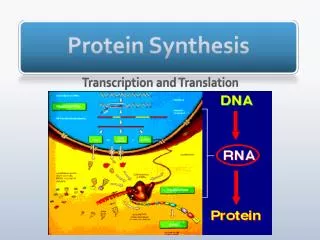
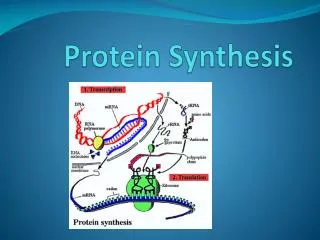
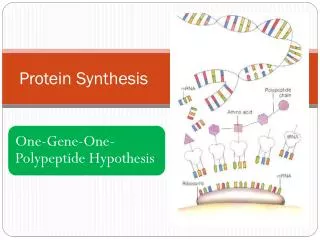
Protein synthesis • Begins in the nucleus (animation) • DNA code of a particular protein is read and used to produce mRNA. • This process is called transcription • The nucleotides are organized in groups of three. • The sequence of bases found in mRNA is called a codon • Each codon codes for a particular amino acid. • Code is determined from the DNA code.
Transcription http://www.scientificpsychic.com/fitness/transcription.gif
mRNA codon-amino acid table http://www.biology.iupui.edu/biocourses/N100/images/13translation.gif
tRNA • Every three bases are called anticodons • tRNAs job is to pick up and transfer amino acids to the ribosome.
Translation • tRNA molecules carry the amino acids to the ribosome to make the protein. The process of the mRNA codon matching its bases with the tRNA anticodon is called translation. • This process verifies the genetic code for the appropriate protein. http://www.accessexcellence.org/RC/AB/WYW/wkbooks/PAP/PAPg/act1translation.gif
Animated protein synthesis websites • http://www.wisc-online.com/objects/index_tj.asp?objID=AP1302 • http://highered.mcgraw-hill.com/sites/0072437316/student_view0/chapter15/animations.html# • http://learn.genetics.utah.edu/content/begin/dna/