Download

1 / 16
160 likes | 275 Vues
This comprehensive guide explores the concept of nouns, including common and proper nouns, concrete and abstract nouns, and collective and compound nouns. Learn the differences between these types of nouns with clear definitions and abundant examples. Discover how to identify and use each type in sentences, enriching your understanding of language. Whether you are a student or an educator, this resource provides valuable insights to enhance your grammatical knowledge.

E N D
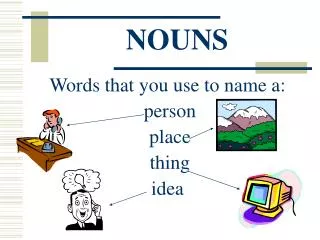
What is a noun? • Person, place, thing, or idea
Common Noun • A common noun names general items • Not capitalized unless they begin a sentence or part of a title. • Walk into the kitchen. What do you see? • Leave the house. Where do you go?
Common Nouns Cont. EXAMPLES: • writer • country • monument • compact disc • book • language • city • mall • grass • girl
Proper Nouns • A proper noun has two different characteristics…. • It will name a specific item • It will begin with a capital letter no matter where it is in the sentence.
Proper Noun Cont. Examples • Ms. Basone • Eiffel Tower • Tennessee • Central Magnet School • George Washington • Batman • Oreo
teacher cookie school college Mr. Patterson Oreo Central Magnet School Louisiana State University Common vs. Proper
What is a CONCRETE NOUN? • Person, place, or thing • Can be perceived by one or more of the senses (sight, hearing, taste, touch, or smell)
Concrete Nouns • Photograph • Music • Baseball • Filmmaker • Opryland • Rose • Peaches
What is an ABSTRACT NOUN? • Names an idea, a feeling, a quality, or a characteristic.
Abstract Nouns • Love • Fun • Freedom • Self-esteem • Beauty • Honor • Wisdom • knowledge
What are COLLECTIVE NOUNS? • Noun that names a GROUP.
Audience Batch Class Committee Herd Crew Family Jury Litter Swarm team Collective Nouns
What is a COMPOUND NOUN? • Noun that is made with two or more words
Compound Nouns • Football • Blackboard • Software • Breakfast • Washing machine • Haircut • Mother-in-law
Practice • Write one sentence using each: • Abstract noun • Collective noun • Compound noun • Concrete noun