Development of a Software Defined Radio Testbed Using MATLAB Simulink and USRP-2
This project focuses on developing a Software Defined Radio (SDR) testbed utilizing MATLAB Simulink and the Universal Software Radio Peripheral (USRP-2). The aim is to evaluate MATLAB Simulink’s capabilities for implementing various digital modulation schemes such as FSK, BPSK, DBPSK, and QAM while adhering to simplified 802.11 MAC protocols. The system design includes the physical and MAC layers, ensuring efficient data transmission and communication coordination among multiple nodes. Testing will validate performance metrics, including bit error rate (BER) and data rates under controlled conditions.

Development of a Software Defined Radio Testbed Using MATLAB Simulink and USRP-2
E N D
Presentation Transcript
Developing a SDR Testbed Alex Dolan Mohammad Khan Ahmet Unsal Project Advisor Dr. Aditya Ramamoorthy
Presentation Overview • Background Information • Project Overview • System Design • Progress and Plan
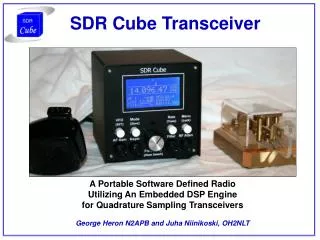
Background Information • Software Defined Radio • USRP-2 • DaughterBoard
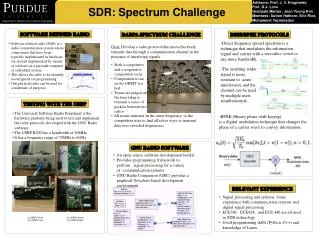
Project Overview Project Goal • Develop a Software Defined Radio network testbed, using MATLAB Simulink and USRP-2 • Evaluate MATLAB Simulink’s Versatility as a SDR platform
Requirements • Implement a SDR Testbed • Use of Universal Software Radio Peripheral-2 (USRP-2) • Use of MATLAB Simulink • Implement digital modulation schemes like FSK, BPSK, DBPSK, QAM • Implement simplified 802.11 MAC
Constraints • USRP-2 • Number of nodes • Frequency Range • Bandwidth • Transmission Power • Processing • CPU Cycles • Time
Assumptions • Tested under reasonable conditions • Normal level of noise • Controlled transmission range
Resources • 2 USRP-2s • Sample rate of 100 MHz • 2 Dell Optiplex 980 Computers • Intel Core i7 Processor • Daughterboards • Various daughterboards for different frequency bands • Able to transmit and receive up to 5 GHz
Design Physical Layer • Design MAC Layer • Testing and Logging Design Process
System Decomposition • Physical layer: • USRP-2 • Simulink – DSP and digital communications • MAC: • Coordinates transmission among nodes. • Testing and Logging: • The tools used to test the system. • Tracks progress and success.
Physical Layer • Simulink signal processing • FSK, PSK, QAM modulation/demodulation • Synchronization and packetization • Error control • USRP-2 hardware • Ethernet interface with 100 MSamples/s A/D conversion
MAC Layer • Coordinate channel access between nodes • Simplified 802.11 implementation • Carrier sense multiple access with collision avoidance (CSMA/CA) • Written in C++ or embedded MATLAB.
MAC • Design a MAC that allows simultaneous transmissions when both interfered messages can be decoded • Distributed Algorithm • Similar to 802.11 distributed coordinate function • Use RTS and CTS messages to coordinate interfering transmissions
Testing and Logging • Select logging/testing options • Logging data to file from individual layers/components • Scopes/Visualization of data from individual layers/components • Generation of statistics • Validation
Design Physical Layer in Simulink. • Design each component in Simulink. • Test in controlled MATLAB environment. • Test using USRP-2 and Simulink. • Introduce MAC layer • Move from point to point and introduce more nodes. • Compare results to simulations and expected results. • Observe BER, data rates, etc. Testing Procedure