SlideServe
Menu
Préférences
© SlideServe · v2026

Cell Cycle Regulation & Cancer Development: Key Pathways & Treatments

thomasmharris avatar
8 diapositives · 222 Views · Jan 03, 2020

Discover the intricate regulation of cell division through checkpoints and key proteins, such as Cyclin, CDKs, p53, and more. Understand how abnormal cell cycle control leads to cancer development and the impact of mutations and tumors. Learn about traditional treatments targeting rapidly dividing cells to combat cancer.
Cell Cycle Regulation & Cancer Development: Key Pathways & Treatments - slide 1
01 / 8Cell Cycle Regulation & Cancer Development: Key Pathways & Treatments
1 / 17

Télécharger la présentation

Cell Cycle Regulation & Cancer Development: Key Pathways & Treatments
Une image / un lien ci-dessous est fourni (tel quel) pour télécharger la présentation

Politique de téléchargement : le contenu du site vous est fourni TEL QUEL pour votre information et votre usage personnel ; il ne peut être vendu, concédé sous licence ni partagé sur d’autres sites sans l’accord de son auteur.Le contenu vous est fourni TEL QUEL, pour votre information et votre usage personnel uniquement. Téléchargez la présentation en cliquant sur ce lien. Lors du téléchargement, si vous ne parvenez pas à télécharger une présentation, l’éditeur a peut-être supprimé le fichier de son serveur.Pendant le téléchargement, si vous ne parvenez pas à obtenir une présentation, le fichier a peut-être été supprimé par l’éditeur.

F I N

Plus de contenu associé

Transcription de la présentation
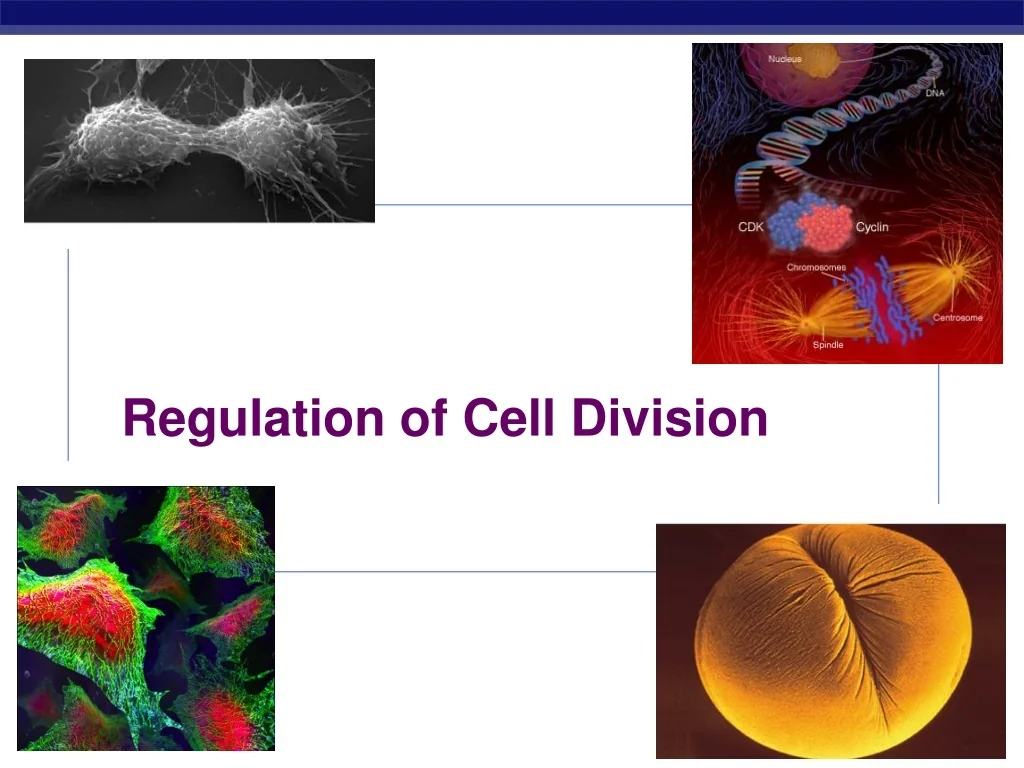
  1. Regulation of Cell Division

  2. M checkpoint G2 checkpoint Chromosomes attached at metaphase plate • Replication completed • DNA integrity Inactive Active Active Inactive Cdk / G2cyclin (MPF) M cytokinesis C mitosis G2 G1 S Cdk / G1cyclin Inactive MPF = Mitosis Promoting Factor Active G1 checkpoint • Growth factors • Nutritional state of cell • Size of cell

  3. Cyclin & Cyclin-dependent Kinases • CDKs & cyclin drive cell from one phase to next in cell cycle • proper regulation of cell cycle is so key to life that the genes for these regulatory proteins have been highly conserved through evolution • the genes are basically the same in yeast, insects, plants & animals (including humans)

  4. Growth Factor Signals growth factor nuclear pore nuclear membrane P P cell division cell surface receptor Cdk E2F protein kinase cascade P chromosome P Rb P E2F Rb nucleus cytoplasm

  5. p53 — Master Regulator Gene NORMAL p53 p53 allows cells with repaired DNA to divide. p53 protein DNA repair enzyme p53 protein Step 2 Step 1 Step 3 DNA damage is caused by heat, radiation, or chemicals. Cell division stops, and p53 triggers enzymes to repair damaged region. p53 triggers the destruction of cells damaged beyond repair. ABNORMAL p53 abnormal p53 protein cancer cell Step 2 Step 1 Step 3 The p53 protein fails to stop cell division and repair DNA. Cell divides without repair to damaged DNA. DNA damage is caused by heat, radiation, or chemicals. Damaged cells continue to divide. If other damage accumulates, the cell can turn cancerous.

  6. What Causes These “Hits”? • Mutations in cells can be triggered by • UV radiation • chemical exposure • radiation exposure • heat • cigarette smoke • pollution • age • genetics

  7. Tumors • Mass of abnormal cells • Benign tumor • abnormal cells remain at original site as a lump • p53 has halted cell divisions • most do not cause serious problems &can be removed by surgery • Malignant tumors • cells leave original site • lose attachment to nearby cells • carried by blood & lymph system to other tissues • start more tumors =metastasis • impair functions of organs throughout body

  8. Traditional Treatments for Cancers • Treatments target rapidly dividing cells • high-energy radiation • kills rapidly dividing cells • chemotherapy • stop DNA replication • stop mitosis & cytokinesis • stop angiogenesis