PRIMARY (P) WAVES
Seismic waves are essential for understanding Earth's interior and the mechanics of earthquakes. There are three main types: Primary (P) waves, Secondary (S) waves, and Surface (L) waves. P waves, the fastest seismic waves, can travel through solids and liquids, squeezing and stretching rocks. S waves are the second-fastest and only travel through solids, pushing rocks side to side. Surface waves, the slowest and most powerful, travel along the Earth's surface, causing the most damage during seismic events. This overview highlights their characteristics and behaviors.

PRIMARY (P) WAVES
E N D
Presentation Transcript
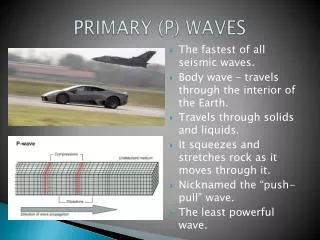
PRIMARY (P) WAVES • The fastest of all seismic waves. • Body wave – travels through the interior of the Earth. • Travels through solids and liquids. • It squeezes and stretches rock as it moves through it. • Nicknamed the “push-pull” wave. • The least powerful wave.
SECONDARY (S) WAVES • The 2nd fastest seismic wave. • Body wave – travels through the interior of the Earth. • Travels only through solids. • It pushes rock side to side as it snakes through it. • It is the 2nd most powerful seismic wave.
SURFACE (L) WAVE • The slowest of all seismic waves. • Surface wave – travels only along the surface of the Earth. • It causes rock to move like ocean waves. • The most powerful wave –it causes the most damage.