Understanding Macromolecules: The Building Blocks of Organic Life
Macromolecules are large, repeating molecules that primarily consist of carbon. Any compound containing carbon is classified as "organic," as carbon readily bonds with hydrogen, oxygen, and nitrogen, forming complex structures. These compounds are assembled from simpler units known as monomers. When two or more monomers bond, they create polymers through processes like condensation reactions or dehydration synthesis, often releasing water. Conversely, polymers can be broken down into monomers through hydrolysis reactions. The primary types of macromolecules include carbohydrates, proteins, lipids, and nucleic acids.

Understanding Macromolecules: The Building Blocks of Organic Life
E N D
Presentation Transcript
What are they? • Large repeating molecules that contain carbon.
Carbon • Any compound that has carbon is called “ORGANIC” • It has 4 valence electrons, so it likes to bond…especially with Hydrogen (H) Oxygen (O) & Nitrogen (N)
Creating Large Carbon Molecules • Carbon compounds are made from simpler molecules • These are called MONOMERS • Two or more monomer are called a POLYMER
Making Polymers • CONDENSATION REACTION • DEHYDRATION SYNTHESIS • Monomer + Monomer = Polymer + H2O (simple) (simple) (complex) (water)
Breaking Polymers • HYDROLYSIS REACTION • Polymer + Water = Monomer + Monomer
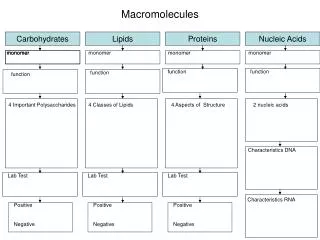
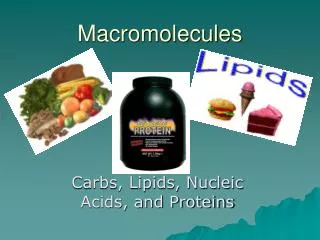
Types of Macromolecules • Carbohydrates • Proteins • Lipids • Nucleic Acids