Download
1 / 10
120 likes | 262 Vues
This study explores sandbox analog models to investigate the basal coefficient of friction and its impact on geological formations. By examining cross-sectional sketches of a mountain through a plate boundary, we analyze the critical taper equation and the relationship between topographic slope and material properties, specifically the angles of internal and basal friction. Additionally, we construct beachball diagrams to illustrate seismogenic instantaneous strain and fault motion characteristics. The models reveal the differences in shear strain rates and velocities associated with varying material properties.

E N D
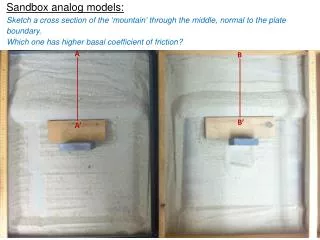
Sandbox analog models: Sketch a cross section of the ‘mountain’ through the middle, normal to the plate boundary. Which one has higher basal coefficient of friction? A B B’ A’
Critical taper equation • The relationship of the topographic slope (α) to • the material properties (angles of internal and basal frictions) • For cohesionless material, (Koons, 1990)
Sandbox analog models: Construct ‘beachball ‘ diagrams showing the seismogenic instantaneous strain and fault motion.
Sandbox analog models: Construct beachball diagrams. Where beachball diagrams show the predominantly strike-slip nature?