SlideServe
Menu
Préférences
© SlideServe · v2026

Simple Squamous Epithelial

trisha avatar
22 diapositives · 1.1K Views · Aug 10, 2014

Simple Squamous Epithelial. Side View. Simple Cuboidal Epithelial. Simple Columnar Epithelial. Stratified Squamous Epithelial. Stratified Cuboidal Epithelial Tissue. Stratified Columnar Epithelial Tissue. Rare – doesn’t occur often in the body. Pseudostratified Columnar Ciliated Epithelial.
Simple Squamous Epithelial - slide 1
01 / 22Simple Squamous Epithelial
1 / 17

Télécharger la présentation

Simple Squamous Epithelial
Une image / un lien ci-dessous est fourni (tel quel) pour télécharger la présentation

Politique de téléchargement : le contenu du site vous est fourni TEL QUEL pour votre information et votre usage personnel ; il ne peut être vendu, concédé sous licence ni partagé sur d’autres sites sans l’accord de son auteur.Le contenu vous est fourni TEL QUEL, pour votre information et votre usage personnel uniquement. Téléchargez la présentation en cliquant sur ce lien. Lors du téléchargement, si vous ne parvenez pas à télécharger une présentation, l’éditeur a peut-être supprimé le fichier de son serveur.Pendant le téléchargement, si vous ne parvenez pas à obtenir une présentation, le fichier a peut-être été supprimé par l’éditeur.

F I N

Plus de contenu associé

Transcription de la présentation
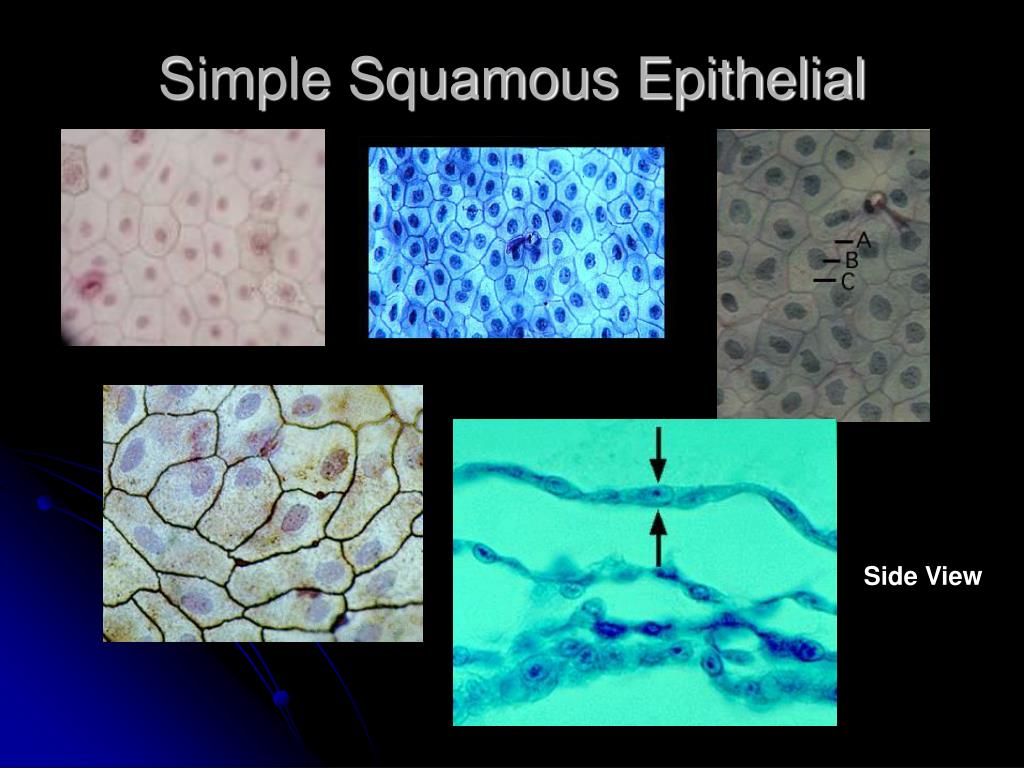
  1. Simple Squamous Epithelial Side View

  2. Simple Cuboidal Epithelial

  3. Simple Columnar Epithelial

  4. Stratified Squamous Epithelial

  5. Stratified Cuboidal Epithelial Tissue

  6. Stratified Columnar Epithelial Tissue Rare – doesn’t occur often in the body

  7. Pseudostratified Columnar Ciliated Epithelial Non-ciliated type

  8. Transitional Epithelial Tissue

  9. What kind of tissue am I?

  10. What kind of tissue am I?

  11. What kind of tissue am I?

  12. What kind of tissue am I?

  13. What kind of tissue am I?

  14. What kind of tissue am I?

  15. What kind of tissue am I?

  16. What is the function of Epithelial Tissue? • Why do cells arrange themselves in single layers or multiple layers? • Simple = allows quick absorption and filtration • Stratified = provides protection

  17. What are the different shapes of Epithelial Tissue? • There are three shapes of epithelial cells: • Squamous – pancake like; flat cells • Cuboidal – length/width/height similar • Columnar – long, rectangular shape

  18. Where would you find certain epithelial cells? • Where would you find squamous? • Simple = forms solid layer of cells which line blood vessels, body cavities (lungs) and covers organs • very thin = controls diffusion and osmosis • Stratified = found mostly in the epidermis (skin)

  19. Where would you find certain epithelial cells? • Where would you find cuboidal? • Mostly simplecuboidal = lines the ducts where absorption and secretion takes place; many are in the kidneys • Stratifiedcuboidal exists, but rare = they protect areas such as ducts of sweat gland, mammary glands, and salivary glands

  20. Where would you find certain epithelial cells? • Where would you find columnar? • Simple columnarepithelial cells form the lining of the stomach and intestines. Some are specialized for sensory reception such as in the nose, ears and the taste buds of the tongue. Goblet cells (unicellular glands) are found between the columnar epithelial cells of the small intestine. They secrete mucus, which acts as a lubricant.

  21. What is the function of cilia? • Cilia are tiny hair-like structures that beat in rhythm to move secretions or objects around. • Examples include tissue in the brain which circulate the cerebrospinal fluid • In the fallopian tubes which move the egg from the ovary to the uterus. • In the respiratory tract, where cells sweep clean dust and germs trapped in mucus

  22. Classification of Epithelial Tissues