Operational Amplifiers
An operational amplifier (op-amp) is a high-gain DC amplifier known for its very high voltage gain, high input impedance, and low output impedance. Initially designed for mathematical operations, op-amps come with voltage and current limitations affecting output capabilities. Peak-to-peak output voltages are constrained by supply voltages, while output current is limited by internal components. A standard op-amp includes a differential amplifier, a voltage amplifier, and a push-pull amplifier, showcasing its versatile internal structure and high-performance characteristics.

Operational Amplifiers
E N D
Presentation Transcript
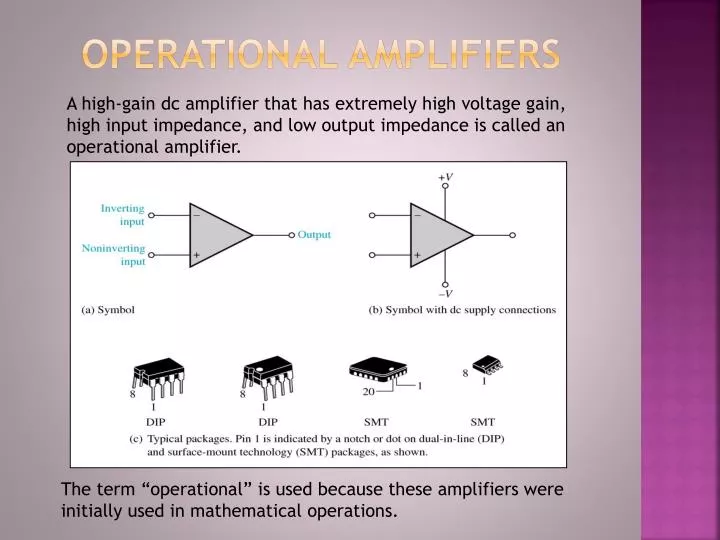
Operational Amplifiers A high-gain dc amplifier that has extremely high voltage gain, high input impedance, and low output impedance is called an operational amplifier. The term “operational” is used because these amplifiers were initially used in mathematical operations.
Practical op-amp characteristics • Op-amps have both voltage and current limitations. • For example: • Peak-to-peak output voltage is usually limited to slightly less than the difference between the two supply voltages. • Output current is limited by internal restrictions such as power dissipation and component ratings. Characteristics of a practical op-amp are high voltage gain, high input impedance, low output impedance, and wide bandwidth
Op-Amp Internal Block Diagram A typical op-amp is made up of three types of amplifier circuits: a differential amplifier, a voltage amplifier, and a push-pull amplifier.