Enhancing Student Learning with Effective Techniques: Strategies for Success
This resource outlines effective learning techniques that can significantly improve student learning outcomes. High utility methods such as practice testing and distributed practice are emphasized as essential strategies. Moderate utility techniques like elaborative interrogation and self-explanation help deepen understanding, while interleaved practice mixes different kinds of problems to enhance retention. Lower utility methods include summarization, highlighting, keyword mnemonics, and rereading. Understanding these techniques enables educators and students to choose the most effective methods for mastery of content.

Enhancing Student Learning with Effective Techniques: Strategies for Success
E N D
Presentation Transcript
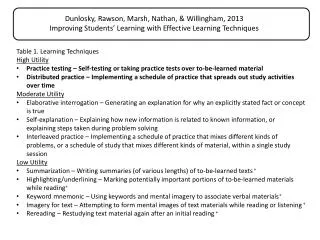
Dunlosky, Rawson, Marsh, Nathan, & Willingham, 2013 Improving Students’ Learning with Effective Learning Techniques • Table 1. Learning Techniques • High Utility • Practice testing – Self-testing or taking practice tests over to-be-learned material • Distributed practice – Implementing a schedule of practice that spreads out study activities over time • Moderate Utility • Elaborative interrogation – Generating an explanation for why an explicitly stated fact or concept is true • Self-explanation – Explaining how new information is related to known information, or explaining steps taken during problem solving • Interleaved practice – Implementing a schedule of practice that mixes different kinds of problems, or a schedule of study that mixes different kinds of material, within a single study session • Low Utility • Summarization – Writing summaries (of various lengths) of to-be-learned texts + • Highlighting/underlining – Marking potentially important portions of to-be-learned materials while reading+ • Keyword mnemonic – Using keywords and mental imagery to associate verbal materials+ • Imagery for text – Attempting to form mental images of text materials while reading or listening + • Rereading – Restudying text material again after an initial reading +