Download
1 / 36
360 likes | 498 Vues
This chapter explores the transition from the Articles of Confederation (AOC) to the US Constitution, emphasizing the strengths and weaknesses of this foundational period. Key successes such as the creation of a republic and the Land Ordinance of 1785 are highlighted, alongside challenges like Shay's Rebellion, which revealed the AOC's frailties. The chapter further discusses the Constitutional Convention's resolutions, representation debates, and the establishment of checks and balances. It concludes with insights into the early administrations of Washington and Jefferson and their enduring impacts on American governance.

E N D
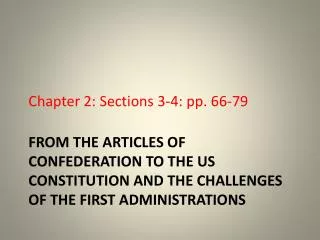
Chapter 2: Sections 3-4: pp. 66-79 From the Articles of Confederation to the US Constitution and the Challenges of the First Administrations
Successes of AOC • Created a Republic • Land Ordinance of 1785 • Surveyed the NW territories • Sold territories to pay for the war • Encouraged settlement in the NW territory • Set land aside for education and religion. • See pages 72-73
Weaknesses Outweighed the Successes • Only one branch – legislative • However required 9 of 13 votes to pass a law • No executive branch to enforce laws • No judicial branch to arbitrate disputes • Unanimity required to amend the AOC • States did not want a strong national gov • Deliberately wanted to keep it weak and the states stronger. • National gov was unable to pass or collect taxes
Shay’s Rebellion • Hero of Battle of Bunker & Saratoga • Returned home to farm but couldn’t pay his taxes because he was never paid for his army service. • When banks tried to foreclose on his property he led rebellion. • Shay’s Rebellion convinced nation that AOC was too weak and that we needed a stronger national government
Constitutional Convention • First issue @Convention dealt with Representation • Virginia Plan • New Jersey Plan • Great Compromise Second Issue was Representation of Slaves Three-Fifths Compromise Federalism Enumerated or delegated powers of fed’lgov Reserved powers to the states
Checks & Balances • Built in the Constitution to prevent any one branch or power from dominating the others. • 3 branches • Federalism • Bill of Rights • Congress • Judicial Review All examples of C/B
Separation of Powers • Legislative Branch – makes laws • Executive Branch – enforces the laws • Judicial Branch – Interprets the laws
Federalism • Division of power between the states and the federal government. • Enumerated powers are those given to the federal government • Reserve powers belong to the states • This is also a check and balance
Federalists & Anti-federalist • Federalists supported the Constitution. • Alexander Hamilton, John Jay & James Madison wrote essays called the FederalistPapers in favor of ratification. • Anti-federalists opposed ratification
Bill of Rights • Anti-Federalists refused to ratify the Constitution without a Bill of Rights. • Federalists didn’t think it was necessary but agreed. • Purpose of BOR was to protect individuals from national government
Amendments • The only way to change the Constitution is through the amendment process. • Congress or 2/3 of states can propose amendment • Needs to be ratified by ¾ of states • Not easy to pass amendment • There have only been 27 • Amendments are one way that the Constitution can change with the times
Washington Administration Ms. Garratt thinks I was the greatest president. Honk if you agree • Civic Duty • First cabinet • Hamilton • Excise • National Bank • Favored industrial elite • Jefferson • Opposed bank • Favored the common man • Whiskey Rebellion • French Revolution • Neutrality
Alexander Hamilton • Became Sec of the Treasury • Proposed • National bank • Excise Tax • Assumption of debt • Strongly opposed by Jefferson • Favored industrial economy & strong central government • Became head of the Federalist party. • Loose interpreter of the Constitution
Thomas Jefferson • Opposed Hamilton’s policies • He’ll become leader of the Republican party • Favored the common man. • Wanted agrarian society • Opposed the National Bank • Believed in state’s rights • Strict interpreter of the Constitution
Whiskey Rebellion • Hamilton wanted to repay nat’l debt following Rev. • Why? • In order to do so an excise tax on whiskey was passed. • Whiskey farmers revolted • Washington led 13,000 to stop rebellion and demonstrate federal gov’s strength
Washington Administration • Had to create gov
Jefferson AdministrationJeffersonian Republicanism • Election of 1800 • Reduced the size of government • Gov became less formal • Madison v. Marbury • Louisiana Purchase • Lewis & Clark • Crisis with Britain & France at sea