Dynamics of Mid-Peripheral Collisions: Analyzing PLF Decay and Isotropy in Fragment Emission
This study investigates the decay dynamics of projectile-like fragments (PLF*) in mid-peripheral collisions, focusing on the different statistical and dynamical behaviors during forward and backward emission. Utilizing experimental setups, we analyze variations in charge splits, relative velocities, and fragment alignment, revealing a significant dependency on whether decay occurs forward or backward. Findings suggest that backward emission is more aligned and exhibits higher asymmetry, challenging traditional statistical models. The correlations derived from the velocities and energy distributions provide a deeper understanding of anisotropy in nuclear fragmentation.

Dynamics of Mid-Peripheral Collisions: Analyzing PLF Decay and Isotropy in Fragment Emission
E N D
Presentation Transcript
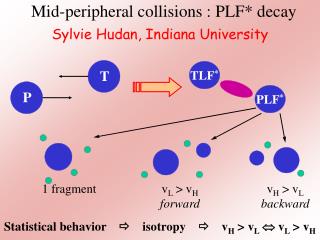
Mid-peripheral collisions : PLF* decay T TLF* P PLF* vL > vH forward vH > vL backward 1 fragment Sylvie Hudan, Indiana University Statistical behavior isotropy vH > vL vL > vH
Experimental setup LASSA : Mass resolution up to Z=9 7 lab 58 Beam Ring Counter : Si (300 m) – CsI(Tl) (2cm) 2.1 lab 4.2 1 unit Z resolution Mass deduced† † : Modified EPAX K. Sümmerer et al., Phys. Rev. C42, 2546 (1990) 48 Projectile 114Cd + 92Mo at 50 A.MeV Miniball/Miniwall Detection of charged particles in 4p
Events with two fragments from a PLF* ZL ZH vL > vH, forward PLF* ZH vH > vL , backward ZL
Anisotropy of PLF* decay Different charge splits more asymmetric split for the backward case Different relative velocities higher vrel for the backward case Different alignments more alignment for the backward case 6 NC 10 B. Davin et al., Phys. Rev. C65, 064614 (2002)
Asymmetry of the breakup :Sensitivity to vPLF* vPLF* vL > vH vH > vL 9.2 x80 x100 x20 8.9 x10 x2 8.6 x1 8.3 E*,J 6 NC 10 B. Davin et al., Phys. Rev. C65, 064614 (2002) • More asymmetric Z distribution for the backward case • Higher asymmetry at high vPLF* (low E*,J) • For all vPLF* , asymmetry for the backward case An other degree of freedom? vprojectile = 9.45 cm/ns
To summarize… • The forward and backward cases are different : • Forward emission is consistent with standard statistical emission • Backward emission is consistent with dynamical decay • Different charge split dynamical has higher asymmetry • Different alignment dynamical is more aligned • Different relative velocity for the same ZL dynamical has higher vrel • Different Z distribution for a given (E*,J)
Well-defined PLF* : ZPLF* and vPLF* dynamical statistical vL > vH vH > vL dynamical • Same correlation expected if vPLF* and E* correlated • More dissipation and fluctuations as ZPLF* decreases • For a given size, less dissipation for the dynamical case
Opening channels 1 fragment (x 0.1) vL > vH vH > vL Dynamical emission opensat higher vPLF* , i.e. lower E* • Up to 10% of the cross-section in the 2 fragment decay
Asymmetry and Coulomb barrier 35 ZPLF* 39 • Higher asymmetry for the dynamical case • Coulomb barrier lower • Dynamical case appears at lower E*
Energy in the fragments • More kinetic energy in the 2 fragments for the dynamical case • For a given vPLF*, difference of 20-30 MeV
A statistical picture : Viola systematics Comparison statistical / Viola At large vPLF*, statistical Viola Deviation for low vPLF* Temperature ? Comparison dynamical / Viola For all vPLF*, dynamical >>Viola More compact shape needed for the dynamical case
Estimation of the temperature Measured Estimated (Viola systematic) Statistical case : vL > vH • Temperatures between 0 and 10-12 MeV • These temperatures are consistent with T=7 MeV from the isotopes in LASSA (for 30 ZPLF* 46)
To summarize… • vPLF* as a good observable : • Samecorrelation(vPLF*)-vPLF* for statistical and dynamical cases • Dynamical case appears at higher vPLF*Coulomb barrier effect • vPLF*(TKE)dynamical > (TKE)statistical by 20-30 MeV • Statistical Viola at high vPLF* and deviation with increasing vPLF* Temperature • Dynamical case always underestimated by Viola
A law : energy conservation ZH ZL + + PLF* E* , BEPLF* TKEH , BEH TKEL , BEL TKEevap , BEevap For a selected vPLF* E* • Kinetic energy in the fragments Higher for the dynamical case • Q value • Evaporated particles
“Missing” energy : Q value? (MeV) • Same Q value in both cases for all vPLF*
“Missing” energy : evaporation? vL > vH statistical vH > vL dynamical Multiplicity of Z=2 emitted forward to the PLF*(in LASSA) • Higher average multiplicities for the statistical case • Deviation of 10-20%
Energy conservation : balance Fixed vPLF* fixed for Z=2 Suggests a longer time scale in the statistical case
A picture of the process Time Saddle-point Scission-point Initial kinetic energy? Q Coulomb Collective TKE “Extra” energy Fluctuations of TKE (Q+Coulomb)-TKE correlation
TKE : width of the distribution • More fluctuations in the dynamical case consistent with an additional kinetic energy at the scission-point
Conversion : Q + Coulomb to TKE Statistical TKE Q + Coulomb Dynamical TKE Q + Coulomb + E0
Conclusions : building a coherent picture Correlation (vPLF*)-vPLF* vPLF* good selector for E* Correlation vPLF* - Mevap Multiplicities of evaporated Z=2 scission,dynamical < scission,statistical Different TKE for all vPLF* Initial TKE at scission Different TKEfor all vPLF* for the dynamical case is Correlation TKE-(Q+Coulomb) larger than the statistical case We observed… We interpreted…
Collaboration • S. Hudan , B. Davin, R. Alfaro, R. T. de Souza, H. Xu, • L. Beaulieu, Y. Larochelle, T. Lefort, V. Viola and R. Yanez • Department of Chemistry and Indiana University Cyclotron Facility, • Indiana University, Bloomington, Indiana 47405 • R. J. Charity and L. G. Sobotka • Department of Chemistry, Washington University, St. Louis, Missouri 63130 • T. X. Liu, X. D. Liu, W. G. Lynch, R. Shomin, W. P. Tan, M. B. Tsang, • Vander Molen, A. Wagner, H. F. Xi, and C. K. Gelbke • National Superconducting Cyclotron Laboratory and Department of Physics and Astronomy, • Michigan State University, East Lansing, Michigan 48824