Exponential Growth of Cholla Cacti and Western Banded Geckos
Explore the exponential growth patterns of Cholla cactus populations and Western Banded Geckos through mathematical principles. Utilizing the growth rate equation, we can determine the future populations without elaborate calculations. For instance, with a starting population of two geckos producing three female offspring annually, we can project a significant increase in their numbers. Additionally, Cholla cacti's growth can lead to immense populations, raising questions about ecological carrying capacity and realism. Discover how these organisms thrive and the factors influencing their growth rates.

Exponential Growth of Cholla Cacti and Western Banded Geckos
E N D
Presentation Transcript
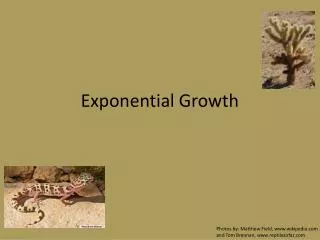
Exponential Growth Photos by: Matthew Field, www.wikipedia.com and Tom Brennan, www.reptilezofaz.com
Cholla Cactus N=1 N=4 N=16
Cholla Cactus N=64
Number of cactus Is there a way to calculate this without drawing trees? Can you figure out the number of trees on year 8, without calculating all of the other years?
Cholla populations • In year 8, there will be… 65,536 cholla! • Does this seem realistic? Why or why not? • Carrying Capacity- The maximum number of plants or animals that can live in a place.
Lizards Western Banded Gecko (Coleonyxvariegatus) 3 female offspring per year How many geckos will there be in 5 years? 35 = 243
Lizards What if there were 2 geckos at the start? 3 female offspring per year Western Banded Gecko (Coleonyxvariegatus)
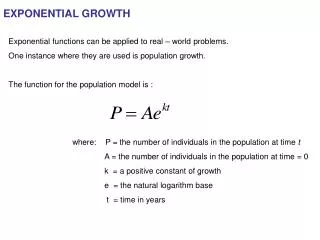
Growth Rate Equation N=S*λt Time New population Growth rate Starting population
Growth Rate Equation N=S*λt Time New population Growth rate Starting population N=(2)*35 N=486 geckos
Growth Rate Equation N=S*λt Time New population Growth rate Starting population Two important points: λ does not need to be a whole number. λ>1 means the population is increasing, and λ<1 means the population is decreasing.
Growth Rate Equation N=S*λt Time New population Growth rate Starting population Example: What if there were 500 geckos, and each year there were only 95% as many geckos as before. How many would there be in 8 years? Answer: 500*(0.95)8 = About 332