Download

1 / 7
70 likes | 180 Vues
This text explores the concept of exponential growth in populations, emphasizing how birth and immigration contribute to population increase, while death and emigration lead to decline. It outlines the calculations for per capita birth and death rates to determine the per capita rate of increase (r). The idea of zero population growth is explained, along with ideal conditions for maximum growth rates. An example of exponential growth is provided through the case of African elephants in Kruger National Park, highlighting both the rapid increase and subsequent collapse of the population due to environmental factors.

E N D
Exponential Growth By Pearl, Kaitlyn, and Maddie
Per Capita Rate of Increase • A certain population will increase in size with every birth and with immigration of individuals from other populations. • It will decrease in size with every death and with emigration.
Calculating Per Capita Rate of Increase • Per capita birth rate (b): ΔN/Δt=B-D • Per capita death rate (d): ΔN/Δt=bN-dN • Per capita rate of increase: r=b-d • Zero Population Growth: r=0
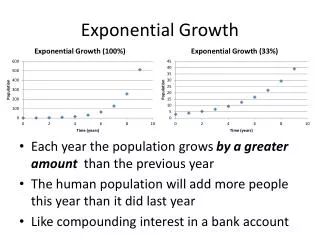
Exponential Population Growth • Also known as geometric population growth • Ideal conditions: Per capita rate of increase may assume the maximum rate of the species (rmax) • ΔN/Δt= rmaxN • Results in a J-shaped curve • The higher the rmax, the faster the population grows.
Positive EPG Negative EPG
Example of Exponential Growth • The J-shaped curve results from introduction of a new population in a new area or a drastic decrease in population size. • African elephants were introduced in Kruger National Park, South Africa • The population later collapsed because the elephants caused damage and food supply was low.