Understanding the Nature and Transformation of Energy
This chapter explores the various forms of energy, including kinetic and potential energy, and details how energy can change from one form to another. Kinetic energy is described as energy in motion, with calculations based on mass and velocity. Potential energy, stored due to an object's position, is discussed, including gravitational and elastic potential energy. The conservation of energy principle is emphasized, illustrating how energy is never created or destroyed, only transformed. Real-life examples demonstrate these concepts, making energy fundamental to understanding physics.

Understanding the Nature and Transformation of Energy
E N D
Presentation Transcript
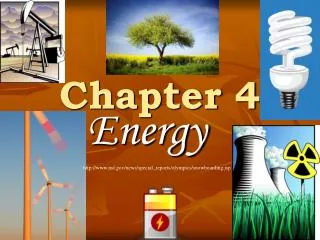
Chapter 4 Energy http://www.nsf.gov/news/special_reports/olympics/snowboarding.jsp
Sec 1. The Nature of Energy • Energy—the ability to cause change. • Energy has several different forms such as • Electrical—making toast or turning on a light • Chemical—energy stored in food or gasoline • Thermal—from the sun, warming the planet • It can be transferred from one form to another.
Kinetic Energy • Kinetic Energy—energy in the form of motion. • Examples—a spinning bicycle wheel, kicking a ball. • The amount of kinetic energy (KE) depends on 2 quantities: • The mass of the moving object and its velocity. • The more mass, the more kinetic energy. • Example: a truck and a motorcycle are both moving at 100 km/hr. Which one has more KE? • Answer: the truck, because it has more mass.
Calculating Kinetic Energy • You can calculate kinetic energy using this equation. • Kinetic Energy = ½ mass x velocity squared • KE = ½ m x v2 • The SI unit of energy is the joule (J)
Potential Energy • Energy does not always involve motion. • Potential Energy—stored energy due to position. • The amount of potential energy (PE) depends on the objects position. • There are different types of potential energy. • Elastic potential energy—energy stored by something that can compress or stretch (ex. rubber band) • Chemical potential energy—energy stored in chemical bonds (ex. gasoline is stored until you start your car)
Gravitational Potential Energy • Gravitational Potential Energy (GPE)—the energy stored by objects that are above Earth’s surface. • The amount of GPE depends on 3 things • Mass, acceleration due to gravity, & height above the ground. • The amount of GPE can be calculated • GPE = mass x 9.8m/s2 x height • GPE = m x 9.8 m/s2 x h or GPE = mgh
Sec 2. Conservation of Energy • Changing forms of energy • When you turn on a light bulb it converts electrical energy into light energy and thermal energy. • Fuel stores energy in chemical bonds. A car engine transforms chemical PE into KE. • Mechanical Energy—the total amount of potential and kinetic energy in a system. • Mechanical energy = PE + KE
Falling Objects • As an object falls, its potential energy decreases and its kinetic energy increases. • The amount of mechanical energy of a falling object always remains the same. • Energy transformation also occurs when a baseball is hit. • Close to the ground it has mostly KE. At its highest point it has mostly PE, but the amount of mechanical energy is constant.
Swinging • On a swing or a pendulum the mechanical energy is also constant. • To get moving, you need KE. As you rise higher, your GPE increases. As you move down, your KE increases. Mechanical Energy is constant.
Law of Conservation of Energy • Law of Conservation of energy—states that energy cannot be created or destroyed. • Sometimes it is hard to see energy conserved. • Ex. Friction can cause some mechanical energy to change into thermal energy (heat). • Ex. The sun can convert a small amount of mass into a large amount of energy using nuclear fusion.
Law of Conservation of Energy Continued • Your body follows the law of conservation of energy. • Ex. Chemical potential energy is stored in the food you eat. • Ex. Your body stores energy in fat and other chemicals. • Ex. Your body converts the energy to make you move.
Google “Energy Changes” • Click on secret lives of energy (2nd) • Find the Energy Change Game • Download and Play • Need the score of …____… for your points!