DNA Structure and Replication: A Comprehensive Guide
Understand the structure of DNA, the nitrogenous bases, Chargaff's Rule, and the scientists behind its discovery. Learn about DNA replication and RNA structures, including the transcription and translation processes. Explore how proteins are made from DNA instructions using different types of RNA.

DNA Structure and Replication: A Comprehensive Guide
E N D
Presentation Transcript
DNA Structure pg: 109
DNA • Deoxyribonucleic Acid (DNA) – holds ALL the instructions for making proteins
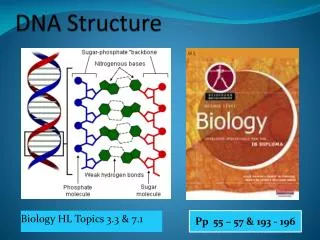
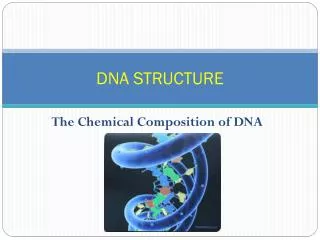
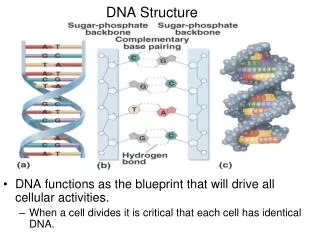
Nucleic Acid (DNA) is made up of nucleotides. Nucleotides are made up of: • Deoxyribose sugar • Phosphate • Nitrogenous base
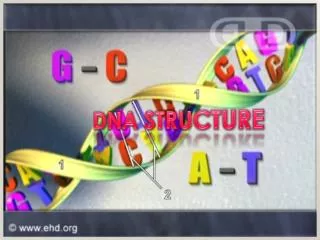
There are 4 different nitrogenous bases: • Adenine (A) • Thymine (T) • Guanine (G) • Cytosine (C)
Adenine Thymine
Guanine Cytosine
Chargaff’s Rule – amount of adenine is equal to the amount of thymine & the amount of guanine is equal to the amount of cytosine
The order of the nitrogenous bases determines the kind of protein made. • ATE and EAT – same letters, different meaning
Adenine Guanine Purines (2 rings)
Thymine Cytosine Pyrimidines (1 ring)
Who’s Who • In the 1950s, James Watson and Francis Crickwere the first to describe the shape of DNA
Rosalind Franklin should also receive credit – without her work, they would not have been able to finish
Shape • DNA has 2 strands • DNA is long so to save space it twists itself into a shape called a double helix
If you flatten DNA it looks like a ladder. The sides of the ladder are made up of alternating phosphates and sugars.
Review • A bonds with • G bonds with • T bonds with • C bonds with T C A G
Adenine (A) • Thymine (T) • Guanine (G) • Cytosine (C) Nitrogen bases
Structure Nitrogen Bases Phosphate Deoxyribose (sugar)
Phosphate Base Sugar
Replication of DNA • DNA Replication – copying DNA to make identical copies • one will be passed along to the new cells during mitosis/meiosis
BONDS Adenine = Thymine Guanine = Cytosine SIDES Phosphate + Sugar
What is the full name for DNA? • What do we call the shape of DNA? • Who first discovered the shape of DNA? • What type of sugar is found in DNA? • What 2 substances make up the sides of DNA? • A phosphate, nitrogenous base, and a sugar make a: • Where in the cell is DNA found? • DNA makes ________ for the body. • What are the nitrogenous bases in DNA? • What does adenine pair with?
DNA Replication Pg: 44
Steps of Replication • An enzyme breaks the bonds holding the two strands together • That enzyme continues down the DNA strand “unzipping” it
Steps of Replication 2. New nucleotides fly in and connect with the open nucleotides • Now there are 2 duplicate DNA strands!
Reading DNA Replication 1.TGGCAATG • ACCGTTAC • 2.GTATGCCA • CATACGGT • 3.AATGCCGT • TTACGGCA • 4.CCCATGAC • GGGTACTG
RNA Structures pg: 53
DNA Replication Review 1.ATGGCT • TACCGA • 2.GCAGTT • CGTCAA • 3.TCGAGA • AGCTCT • 4.TTCCGA • AAGGCT
RNA • Ribonucleic acid (RNA) – translates DNA genetic code into the actual proteins for the cell
RNA • Has single strand • Ribose sugar • NO Thymine, Uracil instead
Comparison DNA RNA Single Strand Ribose sugar Has NO thymine, uses Uracil instead • Double Strand • Deoxyribose sugar • Has thymine
RNA Transcription • DNA ex ATGGCT • Transcription • UACCGA • 1. GCAGTT • DNA • CGUCAA • Transcription • 2. AATGCC • DNA • UUACGG • Transcription • 3. TTGCAG • DNA • AACGUC • Transcription
Protein is what the cell makes! • Amino acid – building blocks of protein
3 types of RNA: • Messenger RNA (mRNA) – brings instructions from the DNA • Transfer RNA (tRNA) – takes amino acids to rRNA • Ribosomal RNA (rRNA) – puts amino acids in the right order to make protein
Step 1 Step 1: Make RNA • Transcription – enzymes use 1 strand of DNA to make an RNA strand (instead of Thymine, uses Uracil)
Step 2 Step 2: Translation – making protein • Codon– 3 letters on the mRNA that code for a protein • Anticodon – a tRNA that matches the codon, carries an amino acid