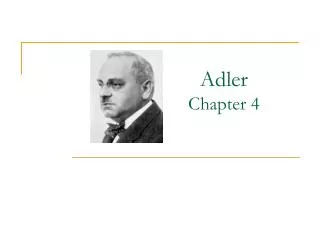
Adler Chapter 4
Adler Chapter 4. Early Influences. Illnesses as a child Poor student at first Older, “perfect” brother Domineering, socialist wife Interest in everyday problems and people Freud. Organ Inferiority Version 1. “Weak” Organs Compensation try to improve weakness, or

Adler Chapter 4
E N D
Presentation Transcript
Early Influences • Illnesses as a child • Poor student at first • Older, “perfect” brother • Domineering, socialist wife • Interest in everyday problems and people • Freud
Organ InferiorityVersion 1 • “Weak” Organs • Compensation • try to improve weakness, or • emphasize other functions to make up for weakness • Overcompensation • Conversion of a biological weakness into a strength
Feelings of InferiorityVersion 2 • Emphasis shifted from physical to subjective inferiorities • All people born “inferior” • The desire to overcome inferiority is the primary motivator in life • Masculine Protest • Inferiority Complex
Striving for SuperiorityVersion 3 • Life Goal: seeking superiority or perfection • Final version: striving for superior or perfect society • Superiority Complex
Vaihinger’s “As If” Philosophy • All experience of “reality” comes through our senses • Humans have a natural tendency to give these sensations meaning, or fictions
Fictional Goals and Lifestyles • “As if” applied to lives of individuals: • Because of past experiences, world views created • Subjective reality more important than physical reality • Lifestyle: ways a person attempts to gain life goals
Creative Self • Free element of the personality that allows a person to choose between alternative fictional goals and lifestyles
Social Interest • Three major problems or goals in life: • Occupational tasks: advance society • Societal tasks: cooperation/division of labor • Love/marriage tasks: procreation
Mistaken Lifestyles • Mistaken Lifestyle: any lifestyle not aimed at socially useful goals • Lifestyle types: • Ruling-dominant type • Getting-leaning type • Avoiding type • Healthy lifestyle must be socially useful
Where do mistaken lifestyles come from? • Physical inferiority • Spoiling/pampering • Neglecting
Safeguarding Strategies • Used by neurotics to save self-esteem • Excuses • Symptoms created to explain short-comings • Aggression • Deprecation • Idealization: use of unrealistic standards to judge others • Solicitude: giving advice to point where you believe others cannot live w/o you • Accusation: blame others for own short-comings • Self-accusation: self-harm w/ the goal of gaining attention
Safeguarding Strategies • Distancing • Moving backward: revert to less complicated time to escape social responsibilities • Standing still: inability to move forward in life • Hesitating: vacillating with problems, delaying, avoiding • Constructing obstacles: creating minor barriers to success • Experiencing anxiety: amplification of all distancing strategies • Using the exclusion tendency: living within narrow limits
Goal of Therapy • Awareness of incorrect old lifestyles and creation of a more healthy lifestyle • Therapists avoids blame or criticism • Prevented from using neuroses to gain sympathy from therapist
Methods of Research • Birth Order • Firstborn • Second born • Youngest • Only
Methods of Research • First Memories • Dream Analysis
Evaluating Adler’s Theory • Empirical Research • Criticisms • Falsifiability • Overly simplistic and optimistic • Contributions • Social variables • Influential
Horney (1885-1952) Part 1
Early Influences • Mother: supportive, independent • Father: very religious, believed women source of evil • Large family, felt unwanted • Bouts w/ depression • Unhappy marriage, sexual promiscuity
Influence of Freud • Trained in Freudian tradition • However, she discover her clients had different problems from the ones that Freud described • Developed her own personality theory to better explain what she saw • Emphasis on culture rather than biology
What causes neuroses? • Social experiences • Esp. important • Relationship between parent and child
Childhood • Two basic needs • Satisfaction • Safety
If… • Need for safety satisfied • Healthy person • Need for safety not satisfied • Parental Indifference: THE "BASIC EVIL" • Neurotic person
Making a Neurotic Person Basic Anxiety Parental Indifference Basic Hostility
10 Neurotic Trends or Needs • Affection/approval • Partner who will run one’s life • Live life in narrow limits • Power • Exploit others
10 Neurotic Trends or Needs • Social recognition and prestige • Personal admiration • Ambition / personal achievement • Independence • Perfection
Adjustment Patterns • moving toward • compliant type • moving against • hostile type • moving away • detached type
What is mental health? neurotic: overemphasizes one orientation healthy:uses all 3 orientations
Neurotic: MOVING TOWARD PEOPLE • needs affection, approval, a partner • compliant, manipulative, temper tantrums • represses competition, rage, anger, hostility • lives life within narrow borders • "poor little me"; martyr; saint Motto: "If I give in, I will not be hurt."
Healthy: MOVING TOWARD PEOPLE In healthy people, "moving toward" enables us to give and receive social support.
Neurotic: MOVING AGAINST PEOPLE • needs control, dominance, recognition and power • hostile, exploitative, perfectionistic, need to be right, Machiavellian, but likeable facade • self-worth success and prestige • chooses a partner to enhance prestige, wealth, or power • identifies with the ideal self Motto: "If I have power, I shall not be hurt."
Healthy: MOVING AGAINST PEOPLE In healthy people, "moving against" enables us to be appropriately assertive Notice that socially approved competition can be a "moving against" symptom
Neurotic: MOVING AWAY FROM PEOPLE • need for privacy • self-sufficient, detached, emotionally flat, lacks goals, overly sensitive to coercion or advice • belittles own potential • vacillates between despised real self and ideal self • attitude of "I don't care about anything" Motto: "If I withdraw, nothing can hurt me."
Healthy: MOVING AWAY FROM PEOPLE In healthy people, "moving away" enables us to be self-reliant (when this is appropriate).