Project UPLIFT
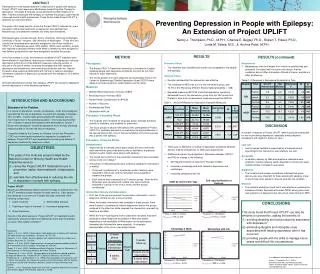
Project UPLIFT aimed to deliver Mindfulness-Based Cognitive Therapy (MBCT) through web and telephone for individuals with epilepsy. This study included 8 sessions focusing on skill-building, support, and mental health outcomes. Participants showed significant improvements in self-compassion and reductions in depressive symptoms compared to waitlist controls. The findings indicate that both web and phone interventions are effective in enhancing mental health and coping strategies for individuals facing epilepsy, with implications for wider applications in mental health interventions.


Project UPLIFT
E N D
Presentation Transcript
Project UPLIFT Main Outcome Results November 6, 2009 Nancy J. Thompson, Ph.D., M.P.H.
Project UPLIFT • Delivery of MBCT by Web and Telephone Groups • To people with epilepsy • Randomly assigned to groups of 7 • Computers and Internet access provided if needed • Groups used for support surrounding Epilepsy • 8 Sessions • Facilitators • Peers and Graduate Students • Supervised by a licensed psychologist • Funding: Centers for Disease Control and Prevention
Each Session • Check-in • Teaching • Group Exercise • Discussion • Skill-building w/ discussion • Review & Homework
Design • Emphasis on Feasibility and Acceptability • Cross-over Design to Explore Effectiveness Stratum 1:Pretest2 gp 8 wk phoneInterimFollow-up Stratum 2:Pretest2 gp8 wk Web InterimFollow-up Stratum 3: PretestInterim2 gp8 wk phone Follow-up Stratum 4: PretestInterim2 gp 8 wk Web Follow-up Baseline Week 8 Week 16
Participation • Screened (n=98) • Excluded (n=34) • Eligible (n=53) • Assessments • Completed Baseline (n=48) • Completed Interim Survey (n=40) • Completed Third Survey (n=35) • Participated in at least one session • Phone Intervention Group (n=12) • Web Intervention Group (n=10) • Phone Waitlist Group (n=10) • Web Waitlist Group (n=10) • 40 (75.5%) participated and completed the assessment following their participation
Data Analysis • Baseline Differences • Only mean Self Compassion was statistically significant (t = 3.00, df = 38, p = 0.005) • Intervention group (mean = 19.7) • Waitlist group (mean = 16.0) • Repeated Measures ANCOVA • Assess the change in scores over time in the intervention and the waitlist groups • Controlled all analyses for Self Compassion
Depression: mBDI • Treatment vs. Waitlist • Foverall = 40.93, p=.0001 • Finteraction = 10.14, p=.003* • Phone vs. Web vs. Waitlist • Foverall = 40.11, p=.0001 • Finteraction = 4.99, p=.012*
Depression: BDI • Treatment vs. Waitlist • Foverall = 42.22, p=.0001 • Finteraction = 11.99, p=.001*
Depression: BDI By Intervention Type • Phone vs. Web vs. Waitlist • Foverall = 41.65, p=.0001 • Finteraction = 5.93, p=.006*
Effect by Presence of MDD * < .05 1Time by Condition 2Time by Condition by MDD
Maintenance of Effects * < .05
Knowledge & Skills • Treatment vs. TAU Waitlist • Foverall = 8.97, p=.005 • Finteraction = 4.75, p=.036* • Phone vs. Web vs. Waitlist • Foverall = 9.67, p=.004 • Finteraction = 3.67, p=.036*
Depression Coping Self-Efficacy • Treatment vs. Waitlist • Foverall = 6.89, p=.013 • Finteraction = 3.59, p=.066
Quality of Life 1.05<p<.10
Satisfaction with Life • Treatment vs. Waitlist • Foverall = 4.52, p=.040 • Finteraction = 3.03, p=.090
Mental Health QOL • Treatment vs. Waitlist • Foverall = 16.07, p=.0001 • Finteraction = 0.12, p=.727 • Phone vs. Web vs. Waitlist • Foverall = 15.10, p=.0001 • Finteraction = 0.50, p=.609
Physical Health QOL • Treatment vs. Waitlist • Foverall = 3.99, p=.053 • Finteraction = 0.50 , p=.486 • Phone vs. Web vs. Waitlist • Foverall = 3.83, p=.058 • Finteraction = 0.31, p=.737
Summary • Effective in: • Reducing depressive symptoms and teaching knowledge and skills associated with reducing depression • Intervention group showed significant improvement compared to the waitlist • Equally effective for those with and without MDD • Reduction in depressive symptoms maintained • Approaching significance for Satisfaction with Life and Depression Coping Self-Efficacy • Delivery • Both phone and web were significantly more effective in reducing depression than waitlist condition
Summary • QOL Findings consistent with the premises of mindfulness • that suffering is not something to turn away from or something in need of fixing, • that it is worthy of attention, • that through attention we can see the ways in which we attach thoughts to the suffering that exacerbate it, and • that letting go of these thoughts reduces suffering (Segal et al.)
Going Forward • ~$1 million Challenge Grant • UPLIFT for Prevention • Participants in 4 states • Georgia • Michigan • Texas • Washington