Acoustic Discrimination in Male Otters: Graphical Representation and Statistical Analysis
Explore the reliability of call-to-caller assignment in male small-clawed otters using Discriminant Functional Analysis. Study social partner discrimination in Asian small-clawed otters based on sounds and scents. Analyze results using acoustic variables such as call duration, harmonics, and fundamental frequency. Study conducted by the Animal and Human Ethology lab at Rennes 1 University, France, led by Dr. Alban Lemasson.

Acoustic Discrimination in Male Otters: Graphical Representation and Statistical Analysis
E N D
Presentation Transcript
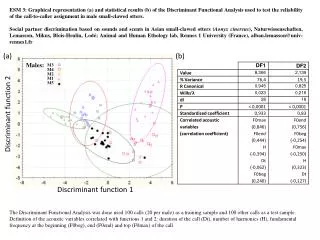
ESM 3: Graphical representation (a) and statistical results (b) of the Discriminant Functional Analysis used to test the reliability of the call-to-caller assignment in male small-clawed otters. • Social partner discrimination based on sounds and scents in Asian small-clawed otters(Aonyxcinereus), Naturwissenschaften, Lemasson, Mikus, Blois-Heulin, Lodé; Animal and Human Ethology lab, Rennes 1 University (France), alban.lemasson@univ-rennes1.fr (a) (b) Males: M3 M4 M2 M1 M5 Discriminant function 2 Discriminant function 1 The Discriminant Functional Analysis was done used 100 calls (20 per male) as a training sample and 100 other calls as a test sample. Definition of the acoustic variables correlated with functions 1 and 2: duration of the call (Dt), number of harmonics (H), fundamental frequency at the beginning (F0beg), end (F0end) and top (F0max) of the call.