Download
1 / 20
200 likes | 306 Vues
This study presents a comprehensive analysis of the flare that occurred on 20 January 2005, as observed during the 6th RHESSI workshop. Key findings include the evolution of various flare emission parameters, showcasing the time profiles of low and high energy gamma-ray emissions, where high-energy emissions are delayed relative to low energy. Distinct features such as the π0 component in phase IB are explored, alongside the comparison of time profiles of the RHESSI and SPRN detectors. The study also delves into plasma temperature changes and challenges in the timing of proton emissions, shedding light on the dynamics of solar flares.

E N D
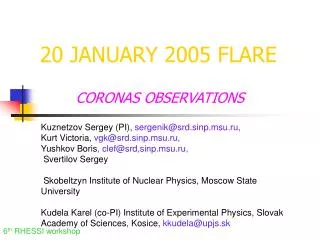
20 JANUARY 2005 FLARE Kuznetzov Sergey (PI), sergenik@srd.sinp.msu.ru, Kurt Victoria, vgk@srd.sinp.msu.ru, Yushkov Boris, clef@srd,sinp.msu.ru, Svertilov Sergey Skobeltzyn Institute of Nuclear Physics, Moscow State University Kudela Karel (co-PI) Institute of Experimental Physics, Slovak Academy of Sciences, Kosice, kkudela@upjs.sk CORONAS OBSERVATIONS 6th RHESSI workshop
20 January 2005 flare Proton onset
Evolution of different parameters of the flare emission The phases correspond to that of 11 JUNE 1991 flare.
Time profiles of the low and high energy gamma-ray emission High energy emission is delayed compared to the low one.
Energy spectra in the phases IA and IB Distinct 0 component is seen in the phase IB. The absolute flux is compared with that of SPRN- X-ray detector onboard CORONAS
Comparison of RHESSI and SPRN time profiles in similar energy windows.
What we see at the end of the phase IB Decay of bremmstrahlung emission becomes more steep than that of 0 emission. It seemsthat variation of the intensities becomes asynchronious.
Plasma temperature begins to decrease at the end of the phase IB
The shortest path of protons L1 =1.055RTime delay of Ep=5 GeV (Vp=0.987c)relative to gamma-rayis 35s Escaping time must be near 06:48 UT Remember that 06:48 UT is the crucial point in the flare development • If the L>L1 than escaping time shifted to more earlier time. ????
R=0.984a.e, γ-ray emission time of flight=490.5s • time of max NM T NM = 06:52:30 UT • corresponds to Ep=500 MeV, • than time delay T NM relative γ-ray emission maximum • Tγ=06:46:30 UT is equal to 360 s . • In this case • proton time of flight is Tflight=(490+360) s. • Vp (500 MeV)=0.76c. • In this case proton path L= Tflight *Vp=1.32R and time difference • between 5 GeV and 500 MeV protons onset time has to be 195 s. • This value correspond l to NM rise time duration..