
The Periodic Table
E N D
Presentation Transcript
Objective • You will be able to discuss the contributions of Mendeleev, Moseley, and Seaborg in the development of the periodic table.
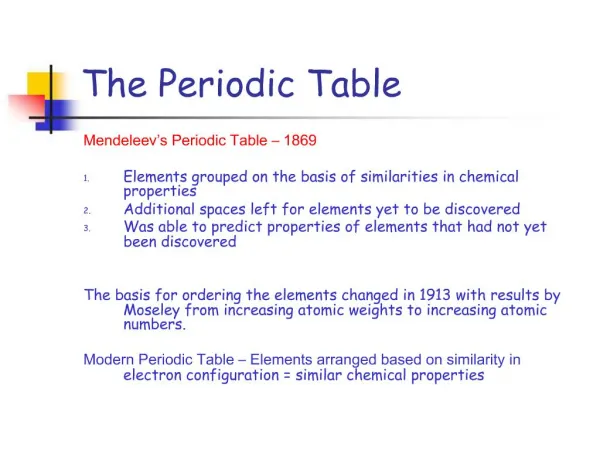
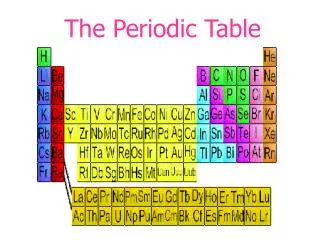
The Periodic Table Dmitri Mendeleev (1869): published first periodic table.
Mendeleev’s Periodic Table • arranged by increasing • atomic mass • grouped by similar • properties • predicted the • existence and properties • of unknown elements • (Ga, Ge, Hf)
Mendeleev’sPredictions Predicted in 1871; Ge was discovered in 1886.
Mendeleev’sQuestion Is the atomic mass of Tellurium (Te) incorrect?
Henry Moseley Henry Moseley (1911): each element has different # of p+. The table should be arranged by atomic number, not atomic mass. Moseley was killed in Turkey during WWI.
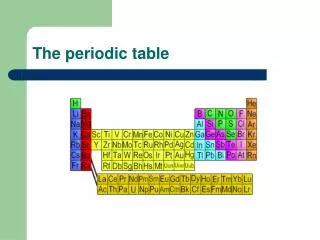
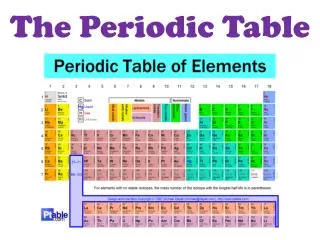
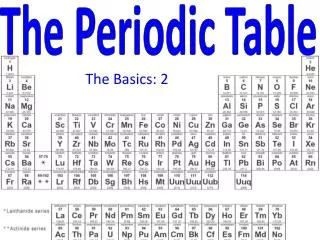
The Modern Table Glenn Seaborg arranged our modern table (d-block and f-block).
Objectives • Know the periodic law. • Explain how atomic radius is measured. • Understand, identify, and discuss the trends on the periodic table for atomic radius and for electronegativity.
Periodic Law periodic law: the properties of the elements repeat periodically “periodicity”
Atomic Radius It is difficult to measure atomic size (no definite edge). atomic radius: ½ the distance between the nuclei of two bonded atoms
Atomic Radius Trends group trend (down a column): radius increases because new energy levels period trend (across a row): radius decreases because electrons are in the same “shell” but added protons pull inward on the shell.
Electronegativity electronegativity: the tendency of an atom to attract electrons when it is bonded to another atom The nucleus of a small atom pulls strongly on the outer electrons of a large atom + + +
Electronegativity Trends group trend: electronegativity decreases (atoms get larger) period trend: electronegativity increases (atoms get smaller)
Objectives • You will be able to compare the reactivity of elements. • You will be able to explain why specific elements are either reactive or unreactive.
Metals and Non-Metals Metals tend to lose their outer “valence” electrons because they are large (low electronegativity). Non-metals tend to attract electrons because they are small (high electronegativity).
Reactivity Trends same group = similar properties (like reactivity) = similar e- configurations metals: largest, with fewest valence e- are most reactive non-metals: smallest, with most valence e- are most reactive (excluding noble gases—outer shell is full) • Which is the most reactive? • Ca, Cu, Rb, Na • S, Cl, Br, C, Ne
Reaction Clips • Alkali Metal Reactions • Sodium and Chlorine Reaction • Fluorine Reactions