CASES - Modeling Subgroup
This project focuses on the coupled bio-physical modeling of carbon flows on the Canadian Arctic Shelf. Experts from Stanford, NYU, and the University of Manitoba collaborate using high- and low-resolution models to analyze various parameters such as salinity, velocity fields, and ice concentration. The initiative emphasizes the importance of collective input for biogeochemical modeling and aims to submit proposals to NSF and NASA. Future plans include addressing tidal dynamics and open boundaries while creating a centralized data bank for enhanced collaboration among participants.

CASES - Modeling Subgroup
E N D
Presentation Transcript
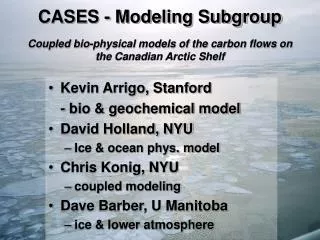
CASES - Modeling Subgroup Coupled bio-physical models of the carbon flows on the Canadian Arctic Shelf • Kevin Arrigo, Stanford - bio & geochemical model • David Holland, NYU • Ice & ocean phys. model • Chris Konig, NYU • coupled modeling • Dave Barber, U Manitoba • ice & lower atmosphere
High Resolution Model (~5 km) Bathymetry
High Resolution Model (~5 km) End of June End of December Salinity Velocity Field
High Resolution Model (~5 km) End of June End of December Ice concentration and velocity
Low Resolution Model • Using AOMIP model output • Providing boundary conditions to the high-res model Sea-Ice Thickness, Beginning of January
Future Plans • Tides • Open Boundaries • Biogeochemical/Ecosystem Modeling:Structure highly dependent on CASES findings-> Input from all participants needed • Proposal to NSF on Feb 15, NASA March Needs • Input from all participants, asap:Central data bank! • Temporal resolution (Franklin Bay, ice camp) • River data