
SlideServe
Menu
Préférences
© SlideServe · v2026

Frame Relay

vivian avatar
10 diapositives · 504 Views · Sep 12, 2014

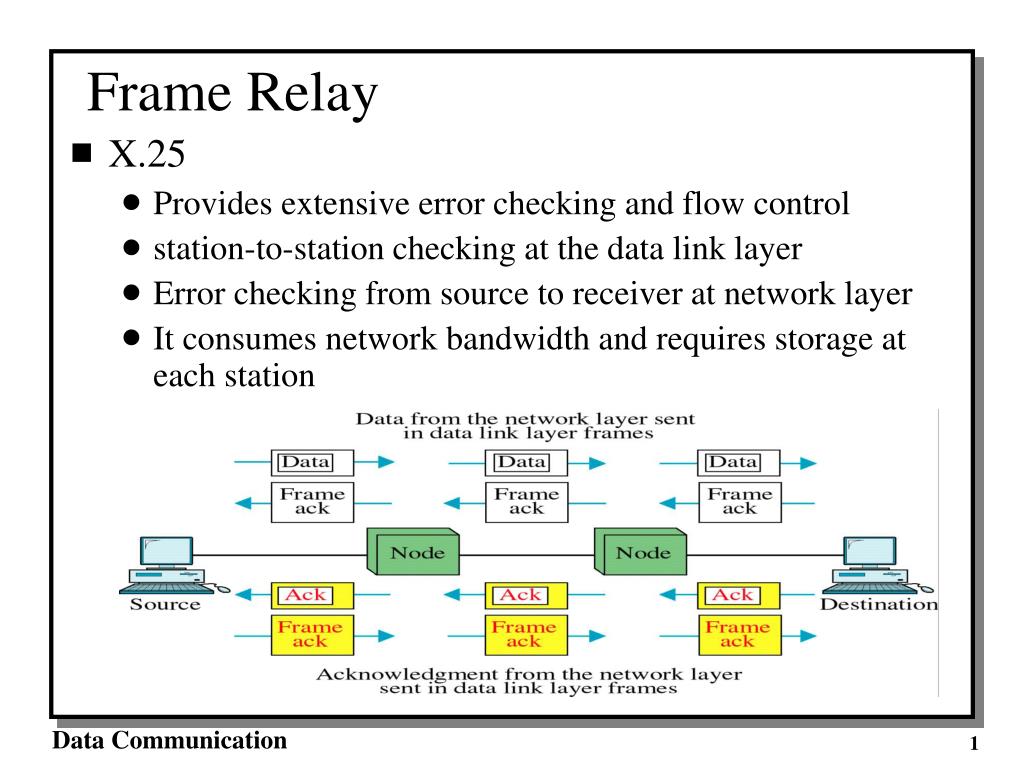
Frame Relay. X.25 Provides extensive error checking and flow control station-to-station checking at the data link layer Error checking from source to receiver at network layer It consumes network bandwidth and requires storage at each station. Frame Relay.
Frame Relay - slide 1
01 / 10Frame Relay
1 / 17

Télécharger la présentation

Frame Relay
Une image / un lien ci-dessous est fourni (tel quel) pour télécharger la présentation

Politique de téléchargement : le contenu du site vous est fourni TEL QUEL pour votre information et votre usage personnel ; il ne peut être vendu, concédé sous licence ni partagé sur d’autres sites sans l’accord de son auteur.Le contenu vous est fourni TEL QUEL, pour votre information et votre usage personnel uniquement. Téléchargez la présentation en cliquant sur ce lien. Lors du téléchargement, si vous ne parvenez pas à télécharger une présentation, l’éditeur a peut-être supprimé le fichier de son serveur.Pendant le téléchargement, si vous ne parvenez pas à obtenir une présentation, le fichier a peut-être été supprimé par l’éditeur.

F I N

Plus de contenu associé

Transcription de la présentation
  1. Frame Relay • X.25 • Provides extensive error checking and flow control • station-to-station checking at the data link layer • Error checking from source to receiver at network layer • It consumes network bandwidth and requires storage at each station

  2. Frame Relay • No error checking and acknowledgment at the data link layer • All error checking is left to the protocols at the network and transport layers • operates at only the physical and data link layers

  3. Frame Relay Layers • Eliminates all of the network layer functions and a portion of conventional data link layer functions. • Physical Layers: no specific protocol is defined for the physical layer. It is left to the implementers.

  4. Frame Relay Layers • Data Link Layer • employ a simplified version of HDLC - HDLC fields for extensive error checking and flow control not needed. • Addressing and control fields combined into one field.

  5. Frame Relay Layers • Frame fields • Addressing(DLCI) fields: two parts (6bits, 4bits). A part of the 16-bit data link connection identifier. • Command/Response(C/R): allows upper layers to identify a frame as either a command or a response. • Extended address (EA):EA=0 another address byte follows, EA=1 the current byte is the final one. • Forward explicit congestion notification(FECN): indicate that traffic is congested in the direction in which the frame is traveling. • Backward explicit congestion notification (BECN) • Discard eligibility (DE) : priority level of the frame

  6. Frame Relay Operation • Transmission is based on permanent virtual circuit • DLCI identifies a permanent virtual circuit that is set up when the system is put in place • Replay • Routing information is included in the destination information. • The path form point A to point D always passes through the same node. • The functions of routing and switching can be handled by the data link layer. • Frame relay (frame switching) occurs at the date link layer where the transmission unit is the frame • Packet switching occurs at the network layer where the transmission unit is the packet

  7. Frame Relay Addresses

  8. Frame Relay Operation • Switching • Two operations of a switch • checks a frame for errors using the FCS field: if an error, discard it • compares the DLCI to an entry in a switch table and find an outgoing port for the PVC identified by the DLCI

  9. Frame Relay Operation • Congestion Control • does not solve the problem, but does provide ways to lessen the probability of its occurrence • A switch in a PVC warns its downstream switches and destination by turning on the FECN bit • The receiver, in turn, set BECN to warn upstream switches and the sender that the link is congested and to send frames more slowly. • This option can not be used unless the channel is either full- or half-duplex and the receiver is sending its own data or acknowledgments to the sender

  10. Frame Relay Implementation • The most likely implementation: Used as a WAN backbone to connect a number of LANs using T-1 links • Frame relay assembler/disassembler(FRADs): assembles and disassembles packets coming from other protocols to allow them to be carried by frame relay frames