Understanding Intermolecular Forces: Key Concepts and Homework Overview
300 likes | 428 Vues
This week, we delve into Chapter 11 on Intermolecular Forces, with OWL homework due by 2/28. Exam #1 results show an average score of 68. We'll explore what happens when water boils, the distinction between bonding and intermolecular forces, and the various types of forces, including ion-dipole, dipole-dipole, and hydrogen bonds. Key trends in enthalpy of hydration and properties of liquids such as vapor pressure and viscosity will also be discussed. Prepare to engage with practical examples and graphical methods to deepen your understanding.


Understanding Intermolecular Forces: Key Concepts and Homework Overview
E N D
Presentation Transcript
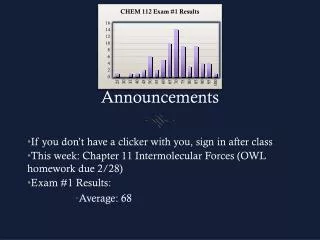
Announcements If you don’t have a clicker with you, sign in after class This week: Chapter 11 Intermolecular Forces (OWL homework due 2/28) Exam #1 Results: Average: 68
Chapter 11 Intermolecular Forces and the Liquid State
What happens when water boils? Draw a picture. Bonding vs. Intermolecular Forces Where do IMF’s come from?
Types of Forces Between MoleculesIntermolecular Forces (IMF’s)
Ion-Dipole Forces: Between dissolved ions and polar molecules Enthalpy of hydration: Trends:
Which would have the highest DHhyd? • Li+ • Na+ • K+ • Ca2+ • Al3+
Dipole- Induced Dipole Forces: Between polar and nonpolar molecules Trends:
Induced Dipole- Induced Dipole Forces: Between nonpolar molecules Trends:
Hydrogen Bonds: Between Molecules with F-H, O-H, or N-H bonds C2H6O Trends:
Which has strongest IMF? • F2 • Cl2 • Br2 • I2
Which has the strongest IMF? • CH3CH3 • CH3OH
Properties of Liquids • Vapor Pressure (volatility) • Boiling Point • Enthalpy of Vaporization • Viscosity • Surface Tension
Molecular interpretation of vapor pressure and boiling. Enthalpy of vaporization:
Example 2. What is the mass of water in the air in this lecture hall? 14 m x 5 m x 17 m T = 22 oC Humidity = 43%
Example 3. A 1-L flask of air is at 30 oC and relative humidity of 68%. The flask is put in a freezer and the temperature decreases to 5 oC. What happens?