Understanding Protein Synthesis: From Nucleotide Sequence to Amino Acids
230 likes | 360 Vues
This overview of protein synthesis highlights the intricate translation of nucleotide sequences into amino acids. Key players include aminoacyl-tRNA synthetases, which facilitate the binding of specific amino acids to their corresponding tRNA during translation. This "second genetic code" ensures that the correct amino acid is delivered to ribosomes through the anticodon loop of tRNA. The text explores two classes of synthetases, codon bias in protein synthesis, and the concept of nonsense suppression, where mutations are compensated to maintain bacterial cell viability.


Understanding Protein Synthesis: From Nucleotide Sequence to Amino Acids
E N D
Presentation Transcript
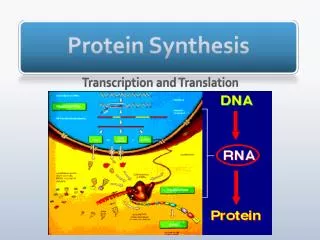
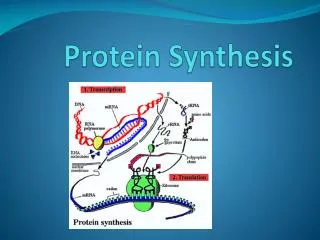
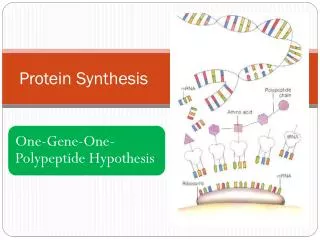
Protein synthesis How a nucleotide sequence is translated into amino acids
Show unusual bases Fig. 11-26
AA-tRNA synthetases • Enzymes that allow the correct amino acid to bind to its cognate tRNA • Considered the “second genetic code”
Aminoacyl-tRNA • tRNA “charged” with amino acid • Carries out codon recognition through anticodon loop • Delivers amino acid to ribosomes • Amino acid has no role in codon recognition
The adapter molecule-tRNA synthetase • 20 amino acids each with its own amino acid tRNA synthetase (aaRS) • Multiple tRNAs for each amino acid use same aaRS • Esterification reaction binds amino acid and cognate tRNA • Synthetase reaction • Activates amino acid for peptide bond formation • Bridges the info gap between amino acids and codons
tRNA synthetases • All synthetases have two major domains • More ancient domain has catalytic site for binding minihelix portion of the tRNA • Divided into two classes • Second domain for interacts with anticodon in most cases • More recent in evolutionary time
Two classes of aa-tRNA synthetases • Class I (2’ esterification) are monomeric • Arg, cys, gln, glu, ile, leu, met, trp, tyr, val • Class II (3’ esterification) are always oligomeric (usually homodimeric) • Ala, asn, asp, gly, his, lys, phe, pro, ser, thr
tRNA recognition • Sequence elements in each tRNA are recognized by its specific synthetase including • 1) One or more of 3 bases in acceptor stem • 2) Base at position 73 “Discriminator base” • (3) In many, at least one anticodon base
Alanyl-tRNAAla synthtase (alaRS) • Single, non-canonical base pair G3:U70 in the acceptor stem defines the recognition • All tRNAAlashave this base pair • If this base pair is altered, recognition does not occur • 24-base microhelix analog is also correctly aminoacylated by alanyl-tRNAAla synthtase
Second genetic code • Sequence and structures of RNA oligos that mimic the acceptor stem and confer specific aminoacylations constitute an operational RNA code for amino acids • Such as code may have predated the genetic code
Codon bias • Some codons are used more than others • In E. coli, occurrence of codons correlates with abundance of tRNAs that read them • Table 30.4
Nonsense suppression • Mutations in gene that alter a sense codon to a stop codon (nonsense) result in premature termination of the protein • Leads to death in bacterial cells • Second mutations in tRNA genes are able to suppress these mutations so the cell can live • Nonsense suppression