Numerical Simulations of Droplet Deformation in Shear Flow Using Lattice Boltzmann Method
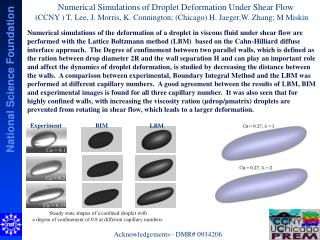
This study investigates droplet deformation in a viscous fluid under shear flow using the Lattice Boltzmann method (LBM) and the Cahn-Hilliard diffuse interface approach. The research examines how the degree of confinement between two parallel walls impacts droplet dynamics by varying wall separation. Comparisons are made between experimental results, the Boundary Integral Method (BIM), and LBM outputs at different capillary numbers, showing good agreement across methods. The study also highlights that high confinement with increasing viscosity ratios restricts droplet rotation, resulting in greater deformation.

Numerical Simulations of Droplet Deformation in Shear Flow Using Lattice Boltzmann Method
E N D
Presentation Transcript
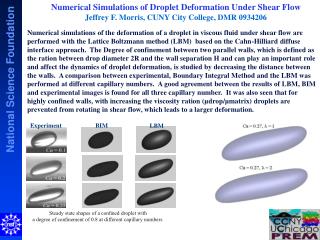
Numerical Simulations of Droplet Deformation Under Shear Flow Jeffrey F. Morris, CUNY City College, DMR 0934206 Numerical simulations of the deformation of a droplet in viscous fluid under shear flow are performed with the Lattice Boltzmann method (LBM) based on the Cahn-Hilliard diffuse interface approach. The Degree of confinement between two parallel walls, which is defined as the ration between drop diameter 2R and the wall separation H and can play an important role and affect the dynamics of droplet deformation, is studied by decreasing the distance between the walls. A comparison between experimental, Boundary Integral Method and the LBM was performed at different capillary numbers. A good agreement between the results of LBM, BIM and experimental images is found for all three capillary number. It was also seen that for highly confined walls, with increasing the viscosity ration (µdrop/µmatrix) droplets are prevented from rotating in shear flow, which leads to a larger deformation. Experiment BIM LBM Steady state shapes of a confined droplet with a degree of confinement of 0.8 at different capillary numbers