Advanced Telescope Performance and Observing Capabilities Overview
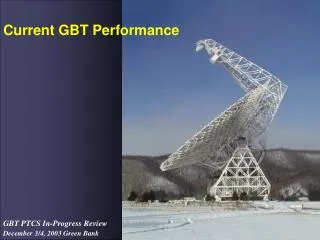
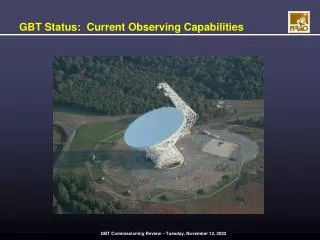
This document provides an overview of the current capabilities and performance metrics of the telescope, focusing on its all-sky pointing accuracy with a root mean square (rms) of approximately 10” and a tracking stability rms of ~2” (5” peak-to-peak). It includes empirical modeling of focus tracking at 800 MHz in Gregorian X-band. Surface efficiency measures at long wavelengths are around 70%, decreasing to ~60% at 20 GHz. The telescope supports various observing modes, including continuum, pulsar, and spectral line observations, highlighting contributions from notable authors like Camilo and Lockman.

Advanced Telescope Performance and Observing Capabilities Overview
E N D
Presentation Transcript
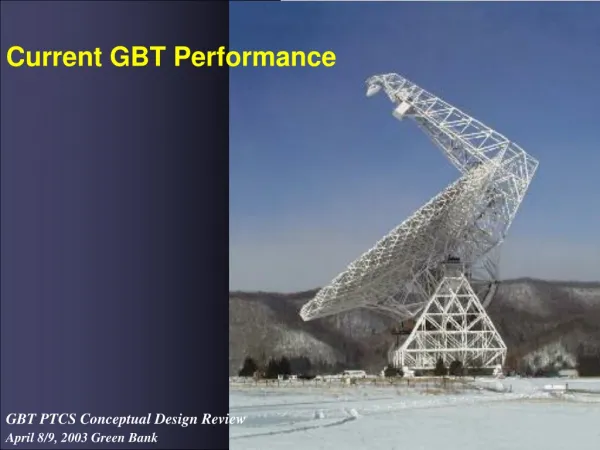
TelescopePerformance - Pointing All-sky pointing rms ~ 10” Tracking stability rms ~ 2” (5” peak-to-peak)
Telescope Performance – Focus Tracking Empirical Model PF (800 MHz) Gregorian (X-band)
Telescope Performance - Surface 70% efficiency at long wavelengths ~60% efficiency at 20 GHz
Observing Modes Continuum (DCR) Pulsar (SP; BCPM; GBPP) Spectral Line (SP; Spectrometer) Camilo et al. (2002) Lockman (2002) GB Staff Radar (PFS) VLBI (VLBA) Campbell et al.