
SlideServe
Menu
Préférences
© SlideServe · v2026

Understanding Earth's Layers and Plate Tectonics

wilmer avatar
14 diapositives · 279 Views · Oct 11, 2014

Explore the four main layers of Earth: the solid inner core, the liquid outer core, the peanut butter-like mantle, and the rocky crust we live on. Learn about how convection currents in the mantle drive plate tectonics, causing the lithosphere to float on the asthenosphere. Discover Alfred Wegener's revolutionary idea of continental drift, which explains how continents have moved over time, supported by evidence such as matching fossils and rock formations. Uncover the mysteries of our dynamic planet!
Understanding Earth's Layers and Plate Tectonics - slide 1
01 / 14Understanding Earth's Layers and Plate Tectonics
1 / 17

Télécharger la présentation

Understanding Earth's Layers and Plate Tectonics
Une image / un lien ci-dessous est fourni (tel quel) pour télécharger la présentation

Politique de téléchargement : le contenu du site vous est fourni TEL QUEL pour votre information et votre usage personnel ; il ne peut être vendu, concédé sous licence ni partagé sur d’autres sites sans l’accord de son auteur.Le contenu vous est fourni TEL QUEL, pour votre information et votre usage personnel uniquement. Téléchargez la présentation en cliquant sur ce lien. Lors du téléchargement, si vous ne parvenez pas à télécharger une présentation, l’éditeur a peut-être supprimé le fichier de son serveur.Pendant le téléchargement, si vous ne parvenez pas à obtenir une présentation, le fichier a peut-être été supprimé par l’éditeur.

F I N

Plus de contenu associé

Transcription de la présentation
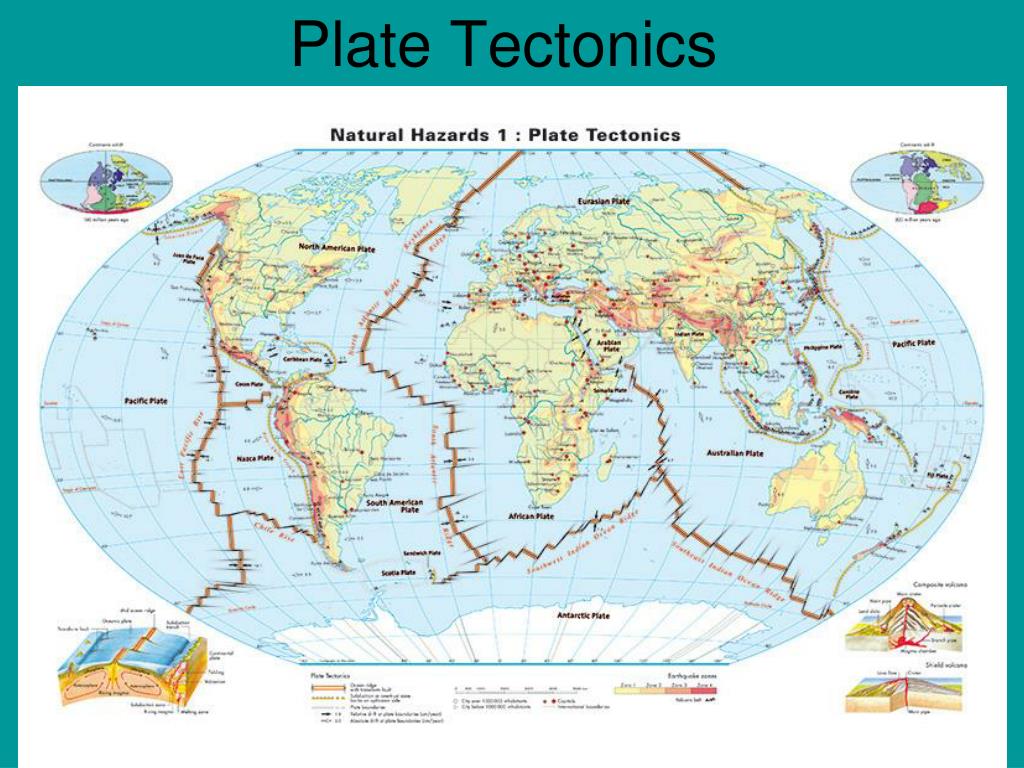
  1. Plate Tectonics

  2. 4 Main Layers • The earth is divided into four main layers based on composition and state of matter.

  3. A. Inner Core • Solid- It is very hot, but it is a solid because it is under so much pressure from all of the layers above it. • Made of SolidIron -very dense metal

  4. B. Outer Core • Liquid • Made of Iron and Nickel

  5. C. Mantle • Liquid- peanut butter-like consistency. It can flow and move, but is almost solid in places. • Made of lighter elements. • Convection Currents occur in the mantle.

  6. D. Crust • Solid, rocky. • We live on the crust • Made of mostly Oxygen and Silicon. • Made up of rocks and sediments. • Divided into Plates that move around on the mantle.

  7. II. Convection in the Mantle • A. Since the mantle is liquid, the material can flow. Convection currents cause the material to move around. • B. Convection Current-when material is heated, it becomes less dense and rises. Then it cools, becomes more dense and sinks again.

  8. III. Plate Tectonics • A. The solid, outer part of the crust and upper mantle is called the LITHOSPHERE. • B. The lithosphere floats on the liquid-like part of the mantle, which is called the ASTHENOSPHERE. The lithosphere is broken into sections called PLATES. The plates get carried along as the asthenosphere moves due to convection currents, like a raft in a river.

  9. IV. Alfred Wegener • A. Alfred Wegener believed the crust of the earth moved as early as the 1800s, but he couldn’t explain what made them move. He called his idea CONTINENTAL DRIFT. He thought the plates moved because of 4 reasons:

  10. # 1- theshapes of the continents look like they fit together like a puzzle. • Pangea- supercontinent when all the continents joined together.

  11. # 2- Fossils on continents beside each other match up.

  12. # 3- Rock types and Mountain ranges on continents beside each other match up.

  13. # 4- Warmclimatefossils are found in Antarctica, and there is evidence of glaciers in places that are now tropical. A possible explanation is the continents moved. Glossipteris- fern fossil found in Antarctica