Understanding the Code: From Nucleic Acids to Proteins
This overview explains how mRNA translates genetic information into proteins, detailing the process from DNA to mRNA to amino acids. It discusses codons, including start and stop signals, and the role of tRNA in amino acid delivery to the ribosome. The concept of "wobble," the redundancy of the genetic code, and the distinctions between prokaryotic and eukaryotic translation processes are also explored. Understanding this intricate system reveals the beautiful coding language of life and its significance in biology.

Understanding the Code: From Nucleic Acids to Proteins
E N D
Presentation Transcript
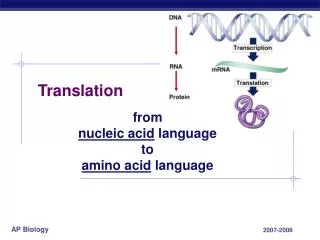
Translation fromnucleic acid languagetoamino acid language
TACGCACATTTACGTACGCGG DNA AUGCGUGUAAAUGCAUGCGCC mRNA MetArgValAsnAlaCysAla protein ? How does mRNA code for proteins? How can you code for 20 amino acids with only 4 nucleotide bases (A,U,G,C)? 4 ATCG 4 AUCG 20
TACGCACATTTACGTACGCGG DNA AUGCGUGUAAAUGCAUGCGCC mRNA AUGCGUGUAAAUGCAUGCGCC mRNA codon MetArgValAsnAlaCysAla protein ? mRNA codes for proteins in triplets called codons: Each codon calls for 1 amino acid
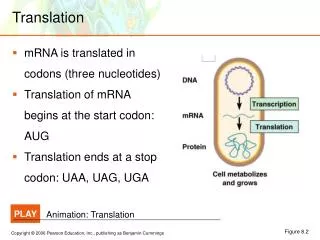
The code • Code for ALL life! • strongest support for a common origin for all life • Code is redundant • several codons for each amino acid • 3rd base “wobble” Why is thewobble good? • Start codon • AUG • methionine • Stop codons • UGA, UAA, UAG
CAU GCA UAC Met Arg Val How are the codons matched to amino acids? tRNA finds the correct amino acid that responds to the codon and brings it to the ribosome 3 5 TACGCACATTTACGTACGCGG DNA 5 3 AUGCGUGUAAAUGCAUGCGCC mRNA codon 3 5 tRNA anti-codon aminoacid
Transfer RNA structure • “Clover leaf” structure • anticodon on “clover leaf” end • amino acid attached on 3 end
Loading tRNA • Aminoacyl tRNA synthetase • enzyme which bonds amino acid to tRNA • bond requires energy • ATP AMP • bond is unstable • so it can release amino acid at ribosome easily Trp C=O Trp Trp C=O H2O OH O OH C=O O activating enzyme tRNATrp A C C mRNA U G G anticodon tryptophan attached to tRNATrp tRNATrp binds to UGG condon of mRNA
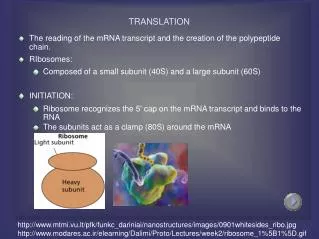
Ribosomes • Facilitate coupling of tRNA anticodon to mRNA codon • organelle or enzyme? • Structure • ribosomal RNA (rRNA) & proteins • 2 subunits • large • small E P A
Ribosomes • A site (aminoacyl-tRNA site) • holds tRNA carrying next amino acid to be added to chain • P site (peptidyl-tRNA site) • holds tRNA carrying growing polypeptide chain • E site (exit site) • empty tRNA leaves ribosome from exit site Met C A U 5' G U A 3' E P A
3 2 1 Building a polypeptide • Initiation • brings together mRNA, ribosome subunits, initiator tRNA • Elongation • adding amino acids based on codon sequence • Termination • end codon release factor Leu Val Ser Met Met Ala Leu Met Met Leu Leu Trp tRNA C A G C G A C C C A A G A G C U A C C A U A U U A U G A A 5' 5' A A 5' C U U 5' A A G G A G U U G U C U U U G C A C U 3' G G U A A U A A C C mRNA 3' 3' 3' U G G U A A 3' E P A
Destinations: • secretion • nucleus • mitochondria • chloroplasts • cell membrane • cytoplasm • etc… Protein targeting • Signal peptide • address label start of a secretory pathway
Can you tell the story? RNA polymerase DNA aminoacids exon intron tRNA pre-mRNA 5' GTP cap mature mRNA aminoacyl tRNAsynthetase poly-A tail 3' large ribosomal subunit polypeptide 5' tRNA small ribosomal subunit E P A ribosome
enhancer translation start translation stop exons 1000+b 20-30b RNA polymerase DNA UTR UTR introns promoter transcription start transcription stop pre-mRNA 5' 3' 5' 3' mature mRNA The Transcriptional unit (gene?) transcriptional unit (gene) 3' 5' TAC ACT TATA DNA GTP AAAAAAAA
Bacterial chromosome Protein Synthesis in Prokaryotes Transcription mRNA Psssst…no nucleus! Cell membrane Cell wall
Prokaryotes DNA in cytoplasm circular chromosome naked DNA no introns Eukaryotes DNA in nucleus linear chromosomes DNA wound on histone proteins introns vs. exons intron = noncoding (inbetween) sequence exon = coding (expressed) sequence Prokaryote vs. Eukaryote genes intronscome out! eukaryotic DNA
Translation in Prokaryotes • Transcription & translation are simultaneous in bacteria • DNA is in cytoplasm • no mRNA editing • ribosomesread mRNA as it is being transcribed
Translation: prokaryotes vs. eukaryotes • Differences between prokaryotes & eukaryotes • time & physical separation between processes • takes eukaryote ~1 hour from DNA to protein • no RNA processing
Any Questions?? What color would a smurf turnif he held his breath?