13 Essential Comma Rules to Enhance Your Writing Clarity
Understanding comma usage is crucial for clear writing. This guide outlines 13 essential rules to help you use commas effectively. From separating items in a list to ensuring clarity between clauses, these rules provide practical examples and insights on mistakes to avoid. Improve your writing by mastering comma placement, avoiding common pitfalls, and knowing when not to use commas. Follow these guidelines to enhance readability and ensure that your sentences convey the intended meaning without confusion.

13 Essential Comma Rules to Enhance Your Writing Clarity
E N D
Presentation Transcript
Correct Commas 13 Rules to Live By Information provided exclusively by: http://www.esf.edu/writingprogram/tipsheets/comma.htm
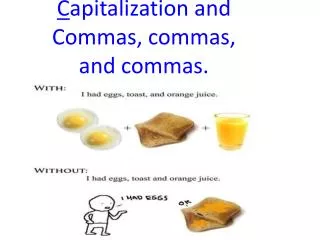
Why? • The comma exists to help readers. • When properly placed, commas clarify meaning by helping readers organize information. • Without it, sentence parts can collide into one another and cause confusion.
Rule #1 • Commas separate items in a series (a list of 3+ things). • Example:The forecast calls for light showers, some clearing, and morning fog.
Rule #2 • Commas separate two independent clauses connected by a coordinating conjunction (and, or, nor, but, so). • Example:Seven men were arrested on the east side, and ten more suspects were taken into custody six hours later.
Rule #3 • Commas set off long introductory clauses and phrases and shorter clauses and phrases that would be confusing without the comma. • Example:When the fire alarm went off for the third time that night, the motel clerk finally called the fire department.
Rule #4 • Commas set off non-restrictive (non-essential) clauses, phrases, and modifiers from the rest of the sentence. • Example of restrictive (essential) clause:Two sisters who sought refuge in a church died when the tornado hit. • Example of non-restrictive (non-essential) clause:Sandra Bullock,who is one of the more in demand actresses of Hollywood, won an Oscar for her performance in The Blind Side.
Rule #5 • Commas separate descriptive modifiers of equal rank. If you can use adjectives interchangeably and can successfully insert the conjunction "and" between them, they are coordinate and require a comma. • Example:Scientists will not predict the next activity of the fickle, explosive volcano.
Rule #6 • Commas set off parenthetical expressions. • Example:These same council members, you may recall, voted themselves a 35 percent pay increase last year.
Rule #7 • Commas are used when the absence of a pause can cause confusion. • Example:For the mayor, going fishing is enough of a vacation.
Rule #8 • Commas are used to set off participle phrases that modify some part of theindependent clause. • Example:The Senate adjourned today, having successfully defeated a filibustering attempt.
Rule #9 • Do not use a comma to separate two independent clauses that are not joinedby a coordinating conjunction. To do so would cause a comma splice. • Example:The inflation rate dipped to 3 percent, the unemployment rate stayed constant.
Alternatives • Use a semicolon to link the clauses: • The inflation rate dipped to 3 percent; the unemployment rate stayedconstant. • Use a coordinating conjunction with a comma: • The inflation rate dipped to 3 percent, but the unemployment ratestayed constant.
Rule #10 • Do not use a comma to introduce a subordinate clause. • (Tip: the use of a comma before the conjunction "because" is one of the biggest offenders.) • Example:The mayor decided to visit the protest site because she needed a firsthand report. • But... if the subordinate clause is being used to introduce the sentence, a comma is required: • Example:Because she needed a firsthand report, the mayor decided to visit the protest site.
Rule #11 • Do not use a comma to separate a noun or pronoun from its reflexive. • Example:Bryant himself will discipline the players.
Rule #12 • Do not use a comma between a word and a phrase that amplifies it if it will create a "false series.“ • Example of a Confusing Series:Rescuers discovered seven bodies, six transients, and one firefighter.BETTER:Rescuers discovered seven bodies-- six transients and one firefighter.
Rule #13 • Don't use a comma to precede a partial quotation. • Example:The mayoral candidate charged that the incumbent was "a charlatan of the lowest order.“ • But... If the quotation is a full sentence, it should be preceded by a comma: • Example:The defense counsel asked, "How would you like to be sent to prison for a crime you didn't commit?"