

SlideServe
Menu
Préférences
© SlideServe · v2026

Sedimentary Rocks

xylia avatar
20 diapositives · 677 Views · Jul 24, 2014

Sedimentary Rocks. II. Rocks. Solid forms of matter that are created in nature that are made of one or more minerals. The three major groups of rocks are: Sedimentary Igneous Metamorphic. A. Sedimentary Rocks. Sediments. Fragments.
Sedimentary Rocks - slide 1
01 / 20Sedimentary Rocks
1 / 17

Télécharger la présentation

Sedimentary Rocks
Une image / un lien ci-dessous est fourni (tel quel) pour télécharger la présentation

Politique de téléchargement : le contenu du site vous est fourni TEL QUEL pour votre information et votre usage personnel ; il ne peut être vendu, concédé sous licence ni partagé sur d’autres sites sans l’accord de son auteur.Le contenu vous est fourni TEL QUEL, pour votre information et votre usage personnel uniquement. Téléchargez la présentation en cliquant sur ce lien. Lors du téléchargement, si vous ne parvenez pas à télécharger une présentation, l’éditeur a peut-être supprimé le fichier de son serveur.Pendant le téléchargement, si vous ne parvenez pas à obtenir une présentation, le fichier a peut-être été supprimé par l’éditeur.

F I N

Plus de contenu associé

Transcription de la présentation
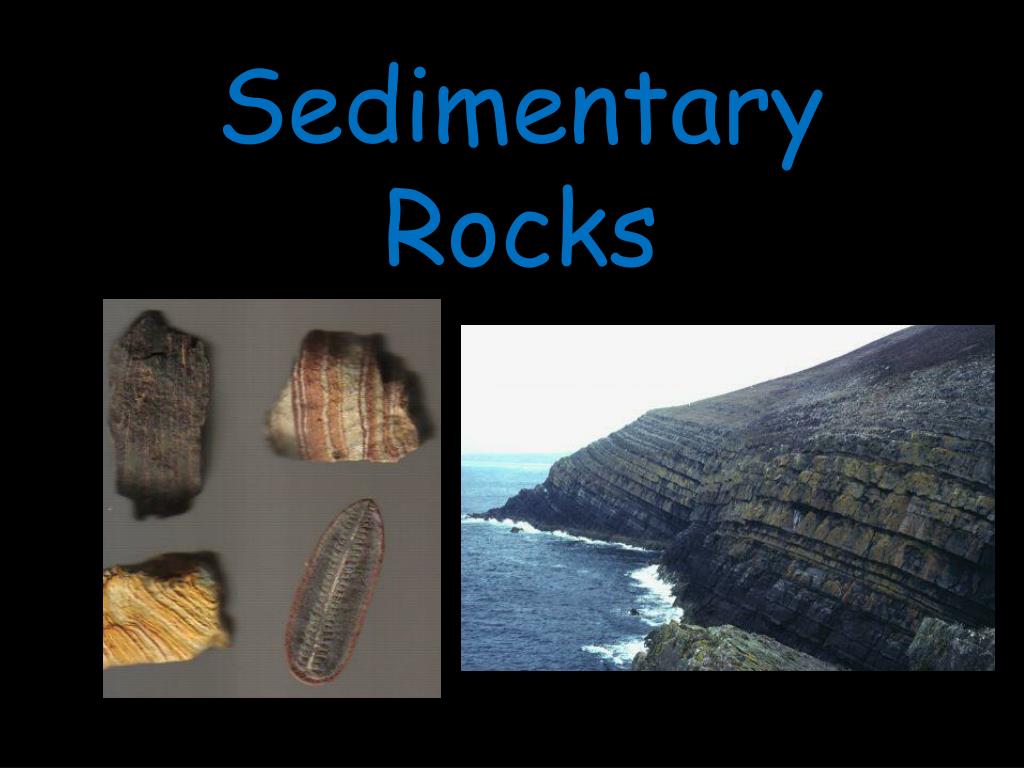
  1. Sedimentary Rocks

  2. II. Rocks Solid forms of matter that are created in nature that are made of one or more minerals. • The three major groups of rocks are: • Sedimentary • Igneous • Metamorphic

  3. A. Sedimentary Rocks Sediments Fragments • Made from ________ or ________ which formed at the surface of the Earth from other rocks. • Rocks at the surface are broken down into sediments by __________ and _________. Weathering Erosion

  4. Water Squeezes • These rocks form in ______, where the weight ________ them down and the minerals dissolved in the water act as the _______ (glue). Cement

  5. Steps to form a Sedimentary Rock: • Weathering & Erosion • Deposition • Compaction • Cementation

  6. Sediments • Sedimentary Rock IDENTIFICATION: • They are made up of __________, which are small fragments of other rocks. • They often show ________ _______, as one layer of sediments is deposited on another in the water. Distinct Layers

  7. Fossils • Sedimentary rocks often contain _______ of once living organisms.

  8. Fossils • These are the only type of rocks that can contain these ______. There are THREE different types of Sedimentary rocks: • _______: Ones that form from rock and mineral fragments which have been __________ and __________ together. Clastic Compacted Cemented Sandstone

  9. Sandstone Siltstone Breccia Shale

  10. Crystalline • __________: ones that form from minerals that were once dissolved in water. The water then begins to evaporate causing the minerals to deposit/precipitate out. These are also called _________. • Can only be classified by ____________, Grain size does not work!! chemical composition Rock Salt Dolostone

  11. Bioclastic • _________: are ones that are made of the remains of organic (once living) things. Limestone Coal

  12. Questions • What is the difference between Conglomerate and Breccia? • Conglomerate contains mostly rounded fragments, while Breccia’s fragments will be more angular. • What is the difference between Sandstone and Siltstone? • Sandstone will have larger fragments than Siltstone. • What is the particle size of Sandstone? • 0.2 to 0.006 cm

  13. How does the composition of Conglomerate compare to the composition of Shale? • The composition of both will be close to the same, but they will have different size particles. • What is the composition of Limestone? • Limestone in made of the mineral Calcite. • What are the ways that Limestone can form? • Shell fragments are cemented together • Precipitates (falls out of) water • Biologic organisms

  14. How does the grain size of Rock Salt compare to the grain size of Rock Gypsum, Dolostone, Coal, and Limestone? • The grain size for each of these will vary or change. • How can you classify the Clastic sedimentary rocks? • Must use their GRAIN SIZE to classify! • How can you classify the Crystalline or Bioclastic Sedimentary rocks? • Must use their COMPOSITION to classify!

  15. ESRT p.6 – Relationship of Transported Particle Size to Water Velocity

  16. less 0.0004cm • What are the grain sizes for the following: (use the chart on page 6 of the ESRT) • Clay: __________ than __________ • Silt: __________ to __________ • Sand: __________ to __________ • Pebbles: __________ to __________ • Cobbles: __________ to __________ • Boulders: __________ than __________ 0.0004cm 0.006cm 0.006cm 0.2cm 0.2cm 6.4cm 6.4cm 25.6cm more 25.6cm