Download
1 / 12
120 likes | 278 Vues
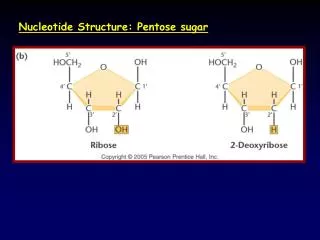
This informative guide explores the intricate structure of nucleotides, consisting of a pentose sugar, nitrogenous bases, and phosphate groups. Nucleotides can contain one to three phosphate groups, connecting via phosphodiester bonds. Highlighting the polarity of nucleic acids, the 5' end features a free phosphate group, while the 3' end ends with a hydroxyl group. Key historical insights into DNA structure are provided, from Rosalind Franklin's early work to Watson and Crick's model. The document also covers DNA replication mechanisms, including template usage and the role of DNA polymerase.

E N D
DNA Linkage • Phosphate group/phosphodiester bond • Nucleotides contain one, two, or three phosphate groups *nucleoside *nucleotide
Nucleic Acid Polarity *Top of molecule has free 5’-phosphate group This is the 5’ end *Bottom has a free 3’ hydroxyl group This is the 3’ end
Structural analysis of DNA *Early 1950’s Rosalind Franklin *1953 Watson and Crick
Nearest Neighbor Analysis (Kornberg 1956): In vitro DNA synthesis •Template DNA •DNA polymerase •dNTPs *dATP *dCTP *dGTP *dTTP •Allow DNA replication to take place •Denature DNA •Treat with micrococcal nuclease- yields mononucleotides with 3’ terminal phosphates
ssDNA treated with micrococcal nuclease: A A C C C * G G T T T T C ssDNA: *
Exercise: List all possible dinucleotides (analysis of nearest 5’ neighbor) Which must be present in equal frequencies if the DNA strands are: Parallel ?Antiparallel?