SlideServe
Menu
Préférences
© SlideServe · v2026

Advanced Patterning Processes for Polymer Brushes Using Direct Assembly Techniques

yardley-rosario avatar
2 diapositives · 199 Views · Nov 18, 2014

This study explores innovative methods for patterning pre-grown polymer brushes through electron beam lithography, enhancing traditional polymerization techniques. Using surface initiated atom transfer radical polymerization (SI-ATRP), we demonstrate the feasibility of direct subsurface patterning of block copolymer brushes. These 3D patterns have potential applications in nanofluidic devices, waveguide materials, and directed nanowire assembly. Our findings reveal precise control over size and location of patterns, significantly advancing polymer brush technology for various applications.
Advanced Patterning Processes for Polymer Brushes Using Direct Assembly Techniques - slide 1
01 / 2Advanced Patterning Processes for Polymer Brushes Using Direct Assembly Techniques
1 / 17

Télécharger la présentation

Advanced Patterning Processes for Polymer Brushes Using Direct Assembly Techniques
Une image / un lien ci-dessous est fourni (tel quel) pour télécharger la présentation

Politique de téléchargement : le contenu du site vous est fourni TEL QUEL pour votre information et votre usage personnel ; il ne peut être vendu, concédé sous licence ni partagé sur d’autres sites sans l’accord de son auteur.Le contenu vous est fourni TEL QUEL, pour votre information et votre usage personnel uniquement. Téléchargez la présentation en cliquant sur ce lien. Lors du téléchargement, si vous ne parvenez pas à télécharger une présentation, l’éditeur a peut-être supprimé le fichier de son serveur.Pendant le téléchargement, si vous ne parvenez pas à obtenir une présentation, le fichier a peut-être été supprimé par l’éditeur.

F I N

Plus de contenu associé

Transcription de la présentation
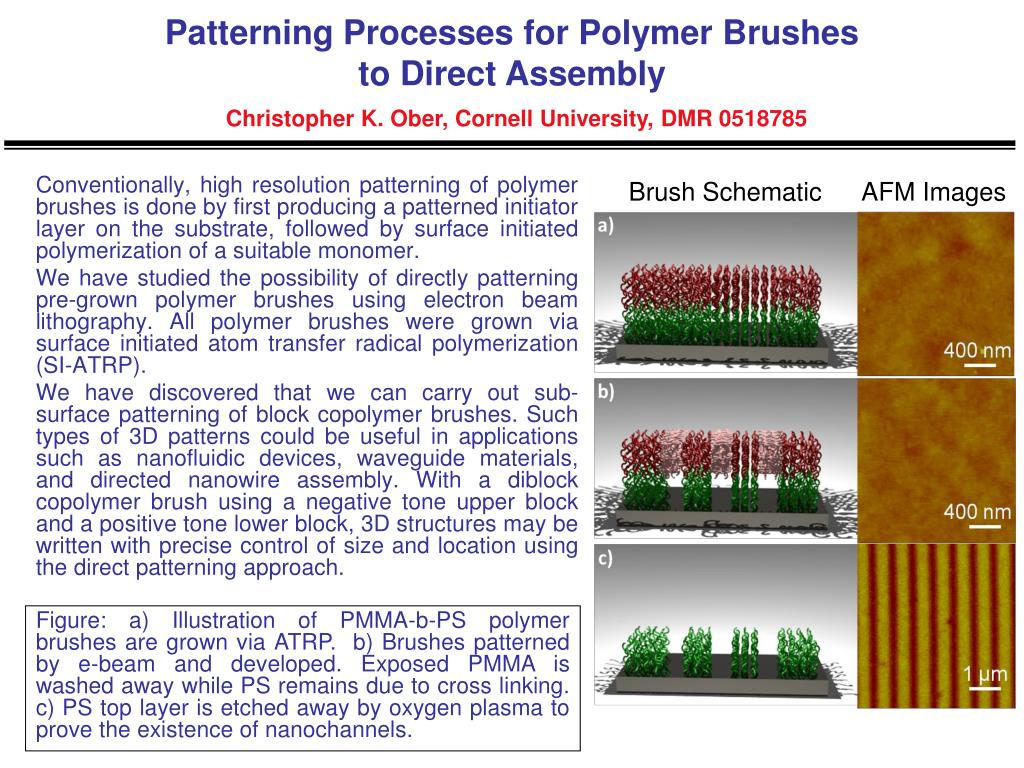
  1. Patterning Processes for Polymer Brushes to Direct AssemblyChristopher K. Ober, Cornell University, DMR 0518785 Brush Schematic AFM Images Conventionally, high resolution patterning of polymer brushes is done by first producing a patterned initiator layer on the substrate, followed by surface initiated polymerization of a suitable monomer. We have studied the possibility of directly patterning pre-grown polymer brushes using electron beam lithography. All polymer brushes were grown via surface initiated atom transfer radical polymerization (SI-ATRP). We have discovered that we can carry out sub-surface patterning of block copolymer brushes. Such types of 3D patterns could be useful in applications such as nanofluidic devices, waveguide materials, and directed nanowire assembly. With a diblock copolymer brush using a negative tone upper block and a positive tone lower block, 3D structures may be written with precise control of size and location using the direct patterning approach. Figure: a) Illustration of PMMA-b-PS polymer brushes are grown via ATRP. b) Brushes patterned by e-beam and developed. Exposed PMMA is washed away while PS remains due to cross linking. c) PS top layer is etched away by oxygen plasma to prove the existence of nanochannels.

  2. Patterning Processes for Polymer Brushes to Direct AssemblyChristopher K. Ober, Cornell University, DMR 0518785 • Ober has created and maintains the IUPAC Polymer Education website – it is one of the Google, Bing and Yahoo top hits for this topic • This site (upper left) is designed to be a resource for students and teachers • Ober is leading efforts by the IUPAC Polymer Division to celebrate 2011, the International Year of Chemistry (IYC) including a writing and video contest on “A World without Polymers • Other outreach activities include hosting REU students, international student exchanges, involvement in teacher workshops and visits to local schools • On lower left, Ober and Prof. Zentel (Mainz) stand with recent exchange students Picture(s)