Immunogenicity vs Antigenicity: Understanding Antibody Binding Dynamics with Small Molecules
This study explores the distinction between immunogenicity and antigenicity, particularly in the context of influenza antigens. We discuss how small molecules, known as haptens, can be immunogenic without being antigenic. By examining various loops and their potential to interfere with binding, we analyze the role of complementarity determining regions (CDRs) in antibody-antigen interactions. The research utilizes techniques to visualize the structural changes in antibodies upon binding, highlighting the intricate dynamics that govern immune responses.

Immunogenicity vs Antigenicity: Understanding Antibody Binding Dynamics with Small Molecules
E N D
Presentation Transcript
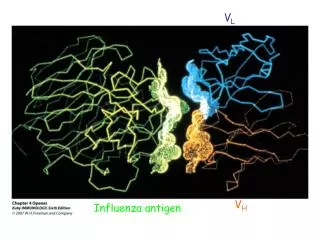
VL VH Influenza antigen
Immunogenicity vs. Antigenicity Induce Combine
Small molecules called haptens are Immunogenic but not Antigenic
What do you predict about the ability of these loops to interfere with binding?
VL VH Complex pulled apart to see complementary surfaces Flu antigen
Lysozyme abs: flat, undulating Small molecules: deeper pockets HA peptide Phos choline ssDNA
HIV Protease in its Ab binding pocket
Unbound Antibody Antibody bound to antigen Conformational Change upon binding Ag
SC: 5 Ig Like domains S-S_ to Fc receptor Proteolytically cleaved