Download
1 / 26
260 likes | 374 Vues
This article explores the evolution of the U.S. government, beginning with the Articles of Confederation, which outlined a weak national structure. It then delves into the Constitutional Convention of 1787, where delegates in Philadelphia created a stronger government by drafting the U.S. Constitution. Key principles such as the separation of powers into the Legislative, Executive, and Judicial branches, as well as the concept of checks and balances, ensure no single branch becomes too powerful. The article also highlights important terms such as citizenship, democracy, and civic engagement.

E N D
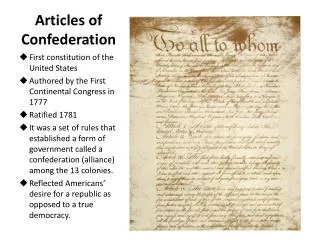
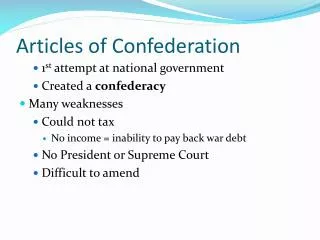
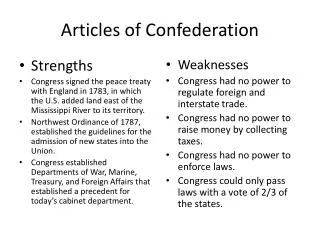
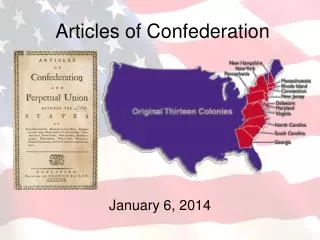
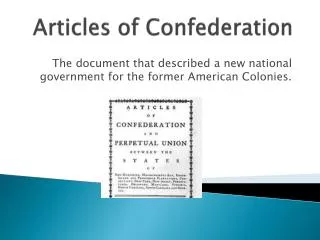
Articles of Confederation The document that described a new national government for the former American Colonies.
Constitutional Convention The meeting of delegates in Philadelphia in 1787 that made plans for a newer, and stronger government. This is when the constitution would replace the Articles of Confederation.
Constitution The document that describes the government of the United States.
Branches of government • Parts of government with different kinds of responsibilities.
Legislative Branch • The branch of government that makes laws.
Executive Branch • The branch of government that carries out laws.
Judicial Branch • The branch of government that interprets laws and settles disagreements about them.
Checks and Balances • In the Constitution, ways of limiting powers to the three branches of government. The Constitution gives one branch the ability to, “check” or stop, the action of another branch. It also divides, or balances, powers so that no branch is too powerful.
Cabinet A group of advisers to the president including the heads of important departments in the Executive Branch.
Treaty A formal agreement between two or more nations.
Impeachment The act of accusing a government official of serious crimes, as defined by the Constitution.
Veto To reject a bill and prevent it from becoming a law.
Unconstitutional An act that goes AGAINST what the Constitution says.
Citizenship • The quality of a person’s responsibilities to his/her town, state, country and world.
Civic Engagement Actions involved to address community concerns.
Democracy A government that is controlled BY THE PEOPLE, FOR THE PEOPLE!
Domestic Tranquilty • Calmness and peace within the country
Enacting • To make into an act or law
Equality • The fact of being equal
Fiscal • Relating to MONEY!
Justice Fairness especially in the way people are treated
Government The institutions, laws, and customsin a political unit
Liberty • The power to have freedom
Freedom • The state of being independent on your choices
Responsibility • The quality of being dependable
Welfare The physical, social, and financial conditions under which somebody may live satisfactorily