Understanding Atomic Structure: Electrons, Nucleus, and Subatomic Particles
70 likes | 193 Vues
This chapter explores the fundamental structure of the atom, summarizing key discoveries in atomic theory. We discuss J.J. Thomson's identification of electrons via cathode rays, the advancement of Rutherford’s gold foil experiment revealing the nucleus, and the defining properties of protons, neutrons, and electrons. An atom is defined as the smallest unit of an element that retains its properties, consisting primarily of a dense nucleus surrounded by a cloud of electrons. The concept of atomic composition emphasizes the balance of positive and negative charges, illustrating that atoms are predominantly empty space.


Understanding Atomic Structure: Electrons, Nucleus, and Subatomic Particles
E N D
Presentation Transcript
Chapter 3.2 The structure of the atom
Objectives • Summarize the observed properties of cathode rays that led to the discovery of the electron. • Summarize the experiment carried out by Rutherford and his co-workers that led to the discovery of the nucleus. • List the properties of protons, neutrons, and electrons. • Define atom.
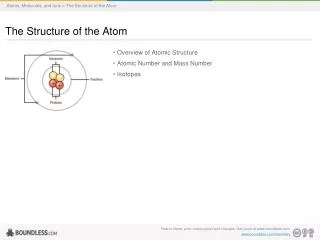
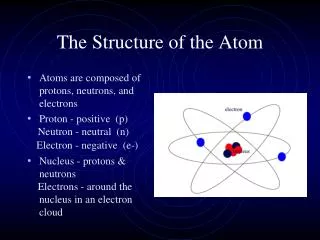
Structure of the Atom • Define atom: smallest particle of an element that retains the chemical properties of that element. • Nucleus • very small region located at the center of an atom • Contains • Protons – positive charged particle • Neutron – particle with NO charge • Area surrounding nucleus • Electron cloud • Electrons – negative charged particle • Subatomic particles Visual Concept – Click Here
Discovery of the Electron • Late 1800’s – J.J. Thomson discovered the electron through experiments with cathode-ray tubes. • Plum Pudding Model of atom • Robert A. Millikan – 1909 – Oil drop experiment • Electron is 1/1837 the mass of hydrogen atom Visual Concept 2 – Click Here Visual Concept 1 – Click Here
Discovery of the Atomic Nucleus • In 1911 – Ernest Rutherford – Gold Foil Experiment • Showed that there was a small – dense positively charged nucleus of an atom. Visual Concept – Click Here
Composition of the Atomic Nucleus • All atomic nuclei are made of protonsand neutrons. • Atoms are electrically neutral - contain equal numbers of protons and electrons Nuclear Forces – Short range proton-neutron, proton-proton, and neutron-neutron forces that hold the nuclear particles together • Sizes of Atoms • Nucleus compared to rest of atom - approximately size of marble compared to a large football stadium. • Atom is mostly empty space