SlideServe
Menu
Préférences
© SlideServe · v2026

Groups/Teams

zea avatar
12 diapositives · 429 Views · Oct 22, 2014

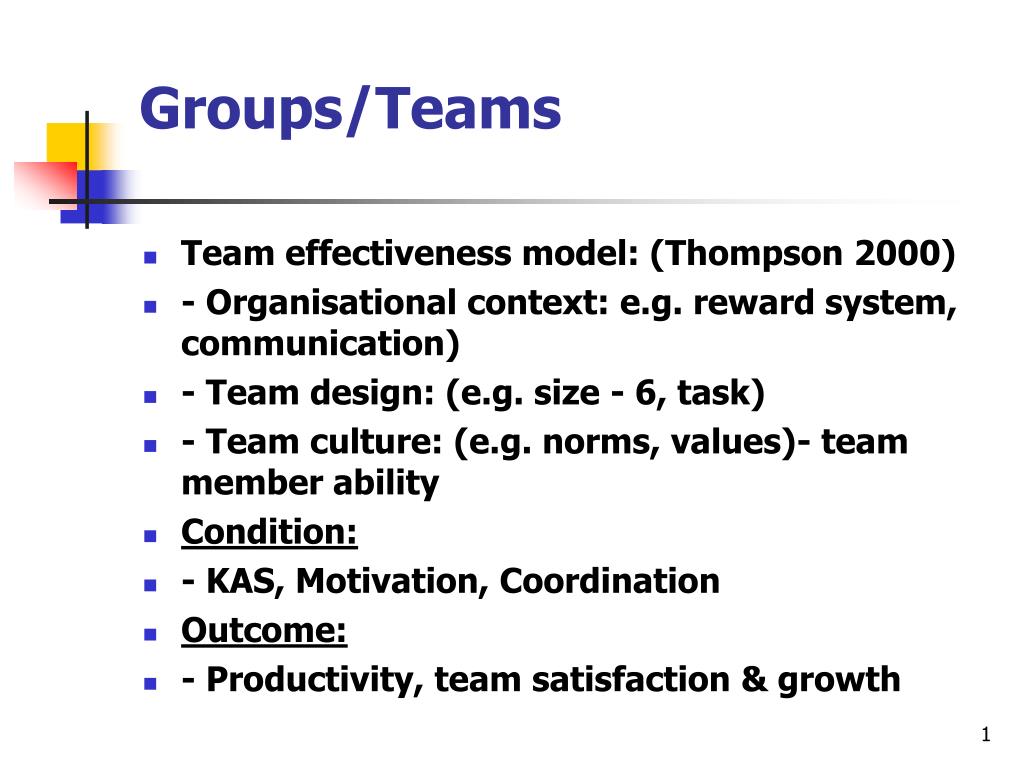
Groups/Teams. Team effectiveness model: (Thompson 2000) - Organisational context: e.g. reward system, communication) - Team design: (e.g. size - 6, task) - Team culture: (e.g. norms, values)- team member ability Condition: - KAS, Motivation, Coordination Outcome:
Groups/Teams - slide 1
01 / 12Groups/Teams
1 / 17

Télécharger la présentation

Groups/Teams
Une image / un lien ci-dessous est fourni (tel quel) pour télécharger la présentation

Politique de téléchargement : le contenu du site vous est fourni TEL QUEL pour votre information et votre usage personnel ; il ne peut être vendu, concédé sous licence ni partagé sur d’autres sites sans l’accord de son auteur.Le contenu vous est fourni TEL QUEL, pour votre information et votre usage personnel uniquement. Téléchargez la présentation en cliquant sur ce lien. Lors du téléchargement, si vous ne parvenez pas à télécharger une présentation, l’éditeur a peut-être supprimé le fichier de son serveur.Pendant le téléchargement, si vous ne parvenez pas à obtenir une présentation, le fichier a peut-être été supprimé par l’éditeur.

F I N

Plus de contenu associé

Transcription de la présentation
  1. Groups/Teams • Team effectiveness model: (Thompson 2000) • - Organisational context: e.g. reward system, communication) • - Team design: (e.g. size - 6, task) • - Team culture: (e.g. norms, values)- team member ability • Condition: • - KAS, Motivation, Coordination • Outcome: • - Productivity, team satisfaction & growth

  2. Tuckman’s model of group development • FORMING • Characterised by uncertainty about • Purpose • Structure • Leadership • STORMING • Marked by • Conflict • Confrontation • May involve redefining tasks & goals • NORMING • Characterised by • Cooperation • Collaboration • Group cohesion begins developing • PERFORMING • Accomplishing assigned tasks via • Energies • Efforts • Commitments • ADJOURNING • Marked by • Positive emotions • Feelings of loss & frustration • Involves in termination of activities Involves termination of activities

  3. Gersick’s model of group development Transition Phase 2 Phase 1 closed from external environment; task definition; info search critical evaluation of progress; setting of new goals implementation of plan; no further evaluation Inertia Redirection Action

  4. Performance outcomes of groups Synergy Total effect is greater than sum of individual efforts ! Potential group performance = Individual performance + Synergy Actual group performance = Potential performance - Faulty group process

  5. Work teams • Leader lead teams: learning stage, member immature, unsure of outcomes • Self managed teams • Interdisciplinary teams • Project teams • (Open Communication + knowledge sharing + networking)

  6. Teams at work • Team characteristics • complementary skills • commitment to common purpose • mutual accountability • Team effectiveness • organisational context • team development • TEAM = together, everyone achieves more • (aware of cultural diversity & support for minority groups)

  7. Team design • Dependent upon: • 1. team task conditions: • independent tasks • dependent tasks • # interdependent tasks – mutual accountability • - sequential (e.g. assembly line), pooled (e.g. GP surgery), reciprocal (e.g.surgical team)

  8. Team implementation • E.g. Self managed teams (Orsburn 1990) • - top management commitment • - trust & risk taking • - information sharing • - training, continuous improvement • - work team mind set • - resources support • - union support

  9. Cohesiveness and groups • What is cohesiveness? • Commonness of attitude, behaviour and performance • What creates cohesion? • high interaction • history of success • similarity • severe initiation • common goal or threat

  10. Process losses • Conflict • Groupthink • Free riders • Social loafers • working in a group with others has the potential to reduce individual effort & performance

  11. Domestic vs Global work teams • Cultural awareness (e.g.PCN, HCN, TCN) • Industry type • management attitude & practices (central vs participative) • global environment • religion & cultural practices • risk exposure • expatriate problems

  12. Global staffing/work teams • Ethnocentric e.g. Telstra, Toyota • Polycentric e.g. HP • Geocentric e.g. Ford • Regiocentric • - PCN, HCN, TCN • Reward package • Repatriation arrangements