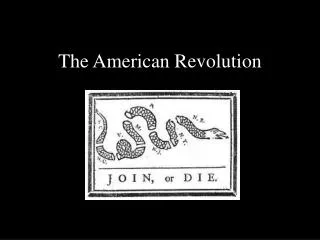
The American Revolution
130 likes | 259 Vues
This summary covers Chapter 7 of Mrs. Kercher's notes on the American Revolution, detailing the early years of the war. It highlights the division among Americans between Patriots, Loyalists, and Neutral parties, as well as the initial preparations for war, the battles in the Middle States, and the strategic importance of events like the Battle of Saratoga. The chapter discusses the involvement of foreign allies, the harsh winter at Valley Forge, and the path to victory with significant battles in the South. It concludes with considerations on the war's legacy and subsequent issues.


The American Revolution
E N D
Presentation Transcript
The American Revolution Chapter 7 notes Mrs. kercher
I. The Early Years of the War A. Americans Divided 1. 40-20-40% -- Patriot, Loyalist, Neutral 2. NE & VA – Patriot, NY & the South – Loyalist 3. Natives, African-Americans, families – split B. Preparing for War 1. Militias, one year enlistments 2. Lacked supplies, training 3. Women helped – Deborah Sampson 4. British well trained, but unmotivated Hessians
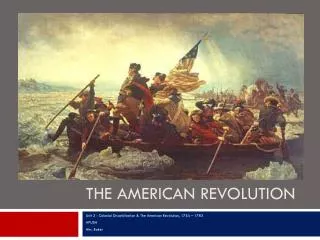
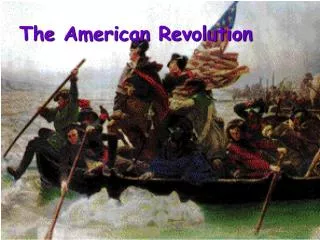
C. War in the Middle States 1. Washington and Howe fought in NY Americans retreated to Pennsylvania a. “These are the times that try men’s souls…” 2. Washington crossed the Delaware a. December 25th, 1776 – Trenton b. 900 Hessians killed or captured, supplies c. improved morale
D. Britain’s Northern Strategy 1. Seize the Hudson River Valley 2. 3 British armies rendezvous failed E. Battles Along the Mohawk 1. Benedict Arnold tricked the British F. Saratoga: A Turning Point 1. British lost several battles around Saratoga 2. Effects – Arnold would become a traitor & Europeans thought Americans could win
II. The War Expands A. Help From Abroad 1. France – money, supplies, troops 2. Spain – SW, Caribbean 3. Britain had to spread out 4. Foreign Officers Arrived a. Lafayette (French) & de Kalb (German)
B. Winter at Valley Forge 1. Tough conditions: lack of food and clothing, disease Americans endured 2. Baron von Steuben trained them C. Frontier Fighting 1. George Rogers Clark – fought and controlled northwest frontier Britain had to spread out even more
D. War on the Waves 1. Britain – most powerful navy in world 2. Privateers – “legal” pirates 3. Famous Naval Battle: The Bonhomme Richard v. Serapis a. John Paul Jones – “ I have not yet begun to fight!” 4. Americans still had to win on land
III. The Path to Victory The Path to Victory A. Savannah and Charles Town 1. British invaded the South a. Reasons: Loyalists, slaves, ports 2. Charles Town – worst American defeat B. The Swamp Fox and Guerrilla Fighting 1. Gates (Am) v. Cornwallis (Br) a. Gates defeated 2. Francis Marion – “Swamp Fox” a. hit-and-run tactics
C. The Tide Turns 1. King’s Mountain – British were murdered 2. Nathaniel Greene – avoided a major battle 3. Opposition to the war in Britain grew D. The End of the War 1. Yorktown (October 1781) a. Washington v. Cornwallis b. French navy cut off British navy c. Cornwallis forced to surrender
E. Why the Americans Won 1. motivation, popular support, leadership, allies, distance, troop strength
IV. The Legacy of the War A. Costs of the War 1. Deaths: about 25000 Am, 10000 Br 2. Unpaid soldiers – got land instead 3. Debt - $27 million 4. Loyalists lost property and fled
B. The Treaty of Paris (1783) 1. US independent 2. Boundaries: Mississippi River, Canada, Florida (ignored natives) 3. Fishing rights, repay debts, return Loyalist property 4. Both sides broke treaty
D. Issues After the War 1. Liberty & Republicanism 2. State governments – constitutions 3. National government – Articles of Confederation 4. Slavery began ending in the North, (PA and MA), but continued in the South 5. Religious freedom 6. Would the states unite?