Understanding Light Reflection in General Physics
Explore the phenomenon of light reflection in physics, detailing how luminous objects create light that is reflected off illuminated objects to our eyes, emphasizing the principles of line of sight, reflection in plane mirrors, image characteristics, and mirror types (concave and convex). Learn about the laws of reflection, image formations, the anatomy of curved mirrors, and the application of ray diagrams. Dive into the concepts of virtual and real images, upright and inverted images, and the role of focal points. Enhance your knowledge of optics and the behavior of light through practical examples and explanations.

Understanding Light Reflection in General Physics
E N D
Presentation Transcript
Reflection General Physics
Why we See Luminous objects create light that is reflected off of illuminated objects to our eyes Line of Sight – in order to see an object, your sight must be directed along a line where the light is reflecting off of that object
Reflection – Plane Mirrors Incident Ray – light ray approaching mirror from object Reflected Ray – light ray that is reflected off of the mirror to your eye
Reflection – Plane Mirrors • Object distance (do) – distance from object to mirror • Image distance (di) – distance from image to mirror • di = d0 • Image location – location in space where it seems to every observer that light is diverging from • Directly across from the object and behind the mirror
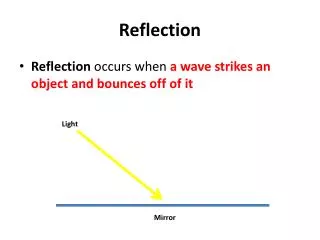
Law of Reflection Angle of incidence = angle of reflection Normal Line (N) – perpendicular to mirror, between I and R
Image Characteristics- Plane Mirrors Virtual image – image that is formed in locations where light does not actually reach (behind mirror) Image is upright Left-right reversal Image and Object dimensions are equal
Ray Diagrams – Plane Mirrors Ray diagram – diagram that uses arrows to trace the path that light takes in order for a person to view the image of an object Light rays travel in straight lines and have direction
Concave Mirrors Law of reflection still holds true do may not equal di - depends on object location Size of image can be larger, smaller, or equal to the size of the object Image can be inverted or upright Image can be real or virtual
Concave Mirror Parts Principal axis – line that passes through the center Vertex – center of mirror (A) Focal Point – point where reflected light meets (F) Focal Length – length from mirror to focal point
Concave Mirror Images Focal point is always in front of the mirror Object forms a real image when placed behind the focal point The Anatomy of a Curved Mirror.htm Ray Diagrams - Concave Mirrors.htm
Reflection from concave mirrors Image location – spot where all light appears to diverge from Incident rays that are parallel to the principal axis reflect through the focal point Incident rays that pass through the focal point will reflect parallel to the principal axis
Convex Mirrors Focal point is always behind mirror All images are virtual Image is always smaller than object Image is always upright do does not equal di
Reflection from Convex Mirrors Any incident ray traveling parallel to the principal axis will reflect so that its extension will pass through the focal point. Any incident ray that has an extension that passes through the focal point will reflect and travel parallel to the principal axis.