Understanding Weather Phenomena: From Stable Conditions to Unstable Hail and Rainfalls
Explore various weather phenomena, including stable and unstable conditions such as hoarfrost, rime, dew, and fog. Learn how hoarfrost forms under calm conditions, while rime develops from supercooled droplets that freeze upon contact with solid surfaces. Understand the processes behind advection and radiation fog, and how rainfall varies by type, including orographic, convectional, and frontal rainfall. This comprehensive overview provides insights into how air rises, cools, and precipitates, contributing to the diverse weather patterns we experience.

Understanding Weather Phenomena: From Stable Conditions to Unstable Hail and Rainfalls
E N D
Presentation Transcript
WeatherPhenomena By: Rodrigo Velarde Paloma Castellano Sebastián Velarde Juan Fernando Bazo
Stable Unstable
Stable HoarFrost Rime Dew Fog - Advection Fog -Radiation
HoarFrost • Looks like a blanket of ice crystals • Moisturedirectly condenses ontoanysurfacebelowfreezingpointtemperature • Developsunderclear, calmconditions
Rime • Rime is a frostcausedbysupercooleddropletsin the air • Rime freezesontoanythingsolid • Coverseverysurface in a film of ice
Dew • Leaveswaterdroplets coveringsurfaces in the morning • Occursoncoolnightswhen moisture in the air condenses butitisnotcoldenoughforittofreeze.
Fog - Advection • Warmed air movesover a coldsurface • Air iscooled and condensationresults • Sea fogs are alwaysadvectionfog.
Fog - Radiation • Cloudsthatformneartheground as result of condensation • Coldlandcoolsthe air aboveit, leadingtomoisture in the air condensing
Unstable Rainfall - Frontal Hail Rainfall - Orographic Rainfall - Convectional
Hail • Hail is a form of solid precipitation • Made of ice and measures between 5 and 200 millimeters in diameter • Hailstones generally fall at higher speeds as they grow in size
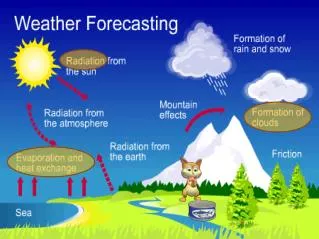
Rainfall - Orographic • When warm air is forsed to rise due to a barrier like a mountain or a slope • As the air rises it cools until it reaches dew point, when clouds are formed • Rainfall occurs on mountain. Areas on the other side of the mountain often have dry climates (Rain shadow effect)
Rainfall - Convectional • The land heats up the air above it • The air rises, it cools, until it reaches dew point temperature. Condensation of moisture creates cloud and rain follows • The hotter the day, the more likely there will be convectional rainfall
Rainfall – Frontal orCyclonic • Occurs when warm and cold air masses meet • The less dense warm air risesabove the cold air • The rising air cools until dew point, condensation, precipitation • Regularly occurs at 60º North and South on the Tri Celular model