Download
1 / 7
70 likes | 195 Vues
This article explores the impact of self-efficacy and locus of control on perceived web efficacy in health seeking. It examines how different types of involvement, such as informational and behavioral, influence health literacy, using updated statistics from "Entertainment Education." The significance of experiential involvement and personal relevance in retaining health information is discussed, alongside the efficacy of tailored interventions for increasing physical activity in older adults. Additionally, the role of platforms like Twitter and YouTube in promoting health literacy is analyzed, highlighting key insights from various studies.

E N D
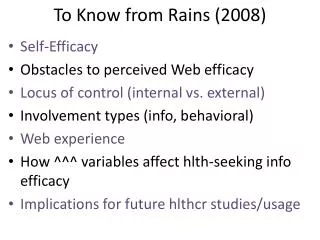
To Know from Rains (2008) • Self-Efficacy • Obstacles to perceived Web efficacy • Locus of control (internal vs. external) • Involvement types (info, behavioral) • Web experience • How ^^^ variables affect hlth-seeking info efficacy • Implications for future hlthcr studies/usage
Stats on Mediated healthcare • https://www.youtube.com/watch?v=qLeNGykRAvU • Know the UPDATED stats (that pop up)
“Entertainment Education”(Johnson, Harrison, & Quick, 2013) • Useful if: • Experiential involvement w/ text & characters • B/c then hlth info recall strong • Personal relevance of EE not important
Websites • Twitter for hlth literacy (Park, Rodgers & Stemmle, 2013) • use more • YouTube videos • Anti-smoking messgsless pos. viewed/commented if: (Paek et al., 2013) • Using • Created • Tailored Interventions: • To increase physactiv in Older Adults (Ammann et al., 2013) • less perceived web-competence, but • highest increase in physical activity • Versus non-tailored (Lustria et al., 2013)
Phones • “Reminders,” Results, & Treatment Info • - for Parents (Ahlers-Schmidt et al., 2012) • Messgbased on formative parental input • Texts preferred method? (Labacher & Mitchell, 2013) • Cessations/Interventions • Smoking • Formative data start on , not future quit day (Bock et al., 2013) • HIV Prevention • White, college hlth info via text (Khosropour et al., 2014)
Games & Apps • Among 127 Apple hlth apps: (Cowan et al., 2013) • Health Belief Model used most • Higher priced & broad activity range • E-training ok, better (Farra et al., 2013)
Technologies • mHealth technologies (Lupton, 2013)