Levels of Organization
160 likes | 286 Vues
This article explores the hierarchical structure of life, detailing the levels of organization from the smallest atoms to complex ecosystems. We begin with atoms, the basic building blocks of matter, and progress through molecules, macromolecules, organelles, cells, tissues, organs, and living organisms. Each level represents increased complexity and interaction, leading to communities and ecosystems. Finally, we examine the biosphere as the global network of life. This framework provides a foundational understanding of biology and the interconnectedness of life on Earth.


Levels of Organization
E N D
Presentation Transcript
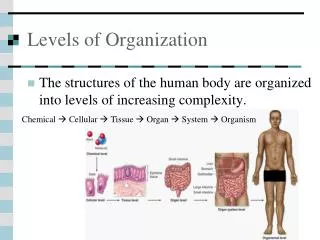
ATOMS • Smallest part of matter • NON-living
Molecules • 2 or more bonded atoms • Form compounds • NON-living
Macromolecule • Very large molecules • Proteins, fats, carbohydrates, nucleic acids • NON-living
Organelles • “Tiny organs” • Made of macromolecules
Cell • Made of organelles • Basic unit of structure & function • LIVING
Tissue • The same kind cell working together • Living
Organs • Tissues that work together • Living
Systems • Organs that work together • Living
Organism • Entire living things (organisms) • Usually made of systems • May be a single cell • Living
Population • Same type of organism living together
Community • Several populations living together • Population interact
Ecosystem • A biotic (living) community plus the abiotic (nonliving) features
Biome • Similar ecosystems on earth together
Biosphere • Whole living layer around the globe • Includes abiotic features http://people.hofstra.edu/geotrans/eng/ch8en/conc8en/envisys.html