High Strain Rate Superplasticity in Ultrafine Grained 5083 Aluminum Alloy
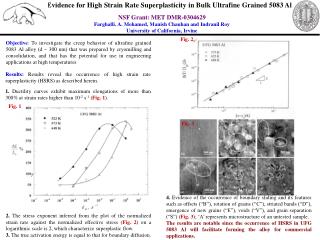
This study investigates the high strain rate superplasticity (HSRS) of ultrafine grained 5083 aluminum alloy, prepared via cryomilling and consolidation. The results demonstrate remarkable ductility, with elongations exceeding 300% at strain rates above 10^-2 s^-1. Features such as boundary sliding, grain rotation, and voids have been identified, indicating HSRS mechanisms. The stress exponent of 2 and activation energy equivalent to boundary diffusion suggest significant potential for engineering applications at high temperatures, facilitating commercial use of this advanced material.

High Strain Rate Superplasticity in Ultrafine Grained 5083 Aluminum Alloy
E N D
Presentation Transcript
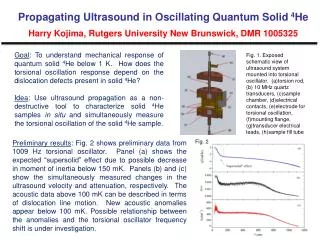
Evidence for High Strain Rate Superplasticity in Bulk Ultrafine Grained 5083 Al NSF Grant: MET DMR-0304629 Farghalli. A. Mohamed, Manish Chauhan and Indranil Roy University of California, Irvine Fig. 2 Fig. 1 Fig. 3 Objective: To investigate the creep behavior of ultrafine grained 5083 Al alloy (d ~ 300 nm) that was prepared by cryomilling and consolidation, and that has the potential for use in engineering applications at high temperatures Results: Results reveal the occurrence of high strain rate superplasticity (HSRS) as described herein. 1.Ductility curves exhibit maximum elongations of more than 300% at strain rates higher than 10-2 s-1 (Fig. 1). 4. Evidence of the occurrence of boundary sliding and its features such as offsets (“B”), rotation of grains (“C”), striated bands (“D”), emergence of new grains (“E”), voids (“V”), and grain separation (“S”) (Fig. 3); ‘A’ represents microstructure of an untested sample. The results are notable since the occurrence of HSRS in UFG 5083 Al will facilitate forming the alloy for commercial applications. 2. The stress exponent inferred from the plot of the normalized strain rate against the normalized effective stress (Fig. 2) on a logarithmic scale is 2, which characterize superplastic flow. 3. The true activation energy is equal to that for boundary diffusion.