
Soil: Composition, Functions, and Properties
E N D
Presentation Transcript
Soils Dr. Kimberly Moore, PhD University of Florida, IFAS Fort Lauderdale Research and Education Center 3205 College Ave. Fort Lauderdale, FL 33314 klock@ufl.edu
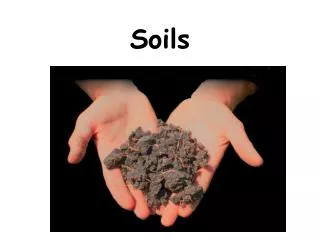
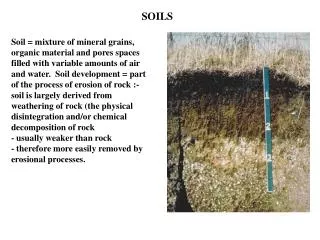
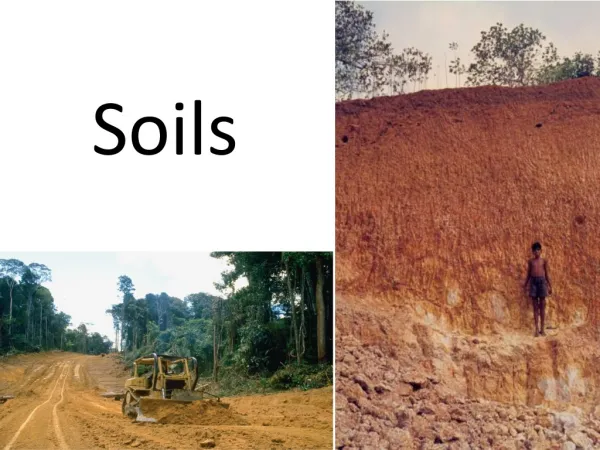
What is soil? • Minerals and rock • Organic matter • Water • Air • Microorganisms
Functions of soil • Support • Air • Water • Nutrients
Particle size • Gravel • Greater than 2.0 mm diameter • Sand • 2.0 to 0.05 mm diameter • Silt • 0.05 to 0.002 mm diameter • Clay • Less than 0.002 mm diameter
Soil definitions • Soil texture • Soil structure https://goo.gl/images/UvNQ77
Organic Matter (Humus) • Peat • Leaf litter/mold • Compost • Manure • Cover crops
Microoganisms (microbes) • Bacteria • Fungi • Mycorrhizae • Protozoans • Nematodes • Insects
Physical Properties Solid Pore = Air and Water
Soil pH https://goo.gl/images/Kbjwri
Criteria of Essentiality • It deficiency prevents the plant from completing its life cycle • It deficiency is specific to the element and can be corrected only by supplying the element • The element has a nutritional role
Macro nutrients • Carbon – C (CO2) • Hydrogen – H (H2O) • Oxygen – O (O2) • Nitrogen – N (NO3 and NH4) • Phosphorus - P (PO4) • Potassium – K (K+) • Calcium – Ca (Ca2+) • Magnesium – Mg (Mg2+) • Sulfur – S (SO4)
Micro nutrients • Iron – Fe • Manganese – Mn • Copper – Cu • Boron – B • Zinc – Zn • Molybdenum – Mo • Chloride - Cl
Source of nutrients • Atmosphere • Inorganic minerals (rocks) • Gypsum, lime, Epsom salts • Organic matter • Manure, compost, bonemeal, bloodmeal • Synthetic fertilizers (inorganic salts) • Controlled-release • Water soluble • Complete • Chelates
Chemistry Review • Elements on the periodic table are called ions • Positive ions are cations • Negative ions are anions Nucleus with protons and neutrons Electrons ATOM
Cation Exchange Capacity (CEC) K+ Ca++ Mg++ NO3- PO4-
Where is our soil? Low CEC High Clay type soils Organic matter Sand
Soilless substrate components • Organic • Peat, bark, coir, manure, compost • Inorganic • Sand, perlite, vermiculite, Styrofoam, rock wool, calcined clay
Peat Moss and Peats • Different types • High water-holding capacity • Low pH • CEC: 7 to 13 me/100cc https://goo.gl/images/w1stqA
Bark • Partially composted and screened • Neutral pH • CEC: 12 me/100 cc https://goo.gl/images/5m9EVi
Coir • Coconut fibers • High water holding capacity • pH of 4.9 to 6.8 • CEC: 6.1 me/100 cc • Low decomposition rate
Compost and Manure • High water-holding capacity • High CEC • Varied nutrient content https://goo.gl/images/rn18jX
Sand • Low water-holding capacity • Low to no CEC • Added for aeration and drainage • Heavy https://goo.gl/images/vofP7B
Perlite • Siliceous volcanic rock that is crushed and heated to 1800°F • Neutral pH • Low to no CEC • Aeration • Light https://goo.gl/images/YDgeSY
Vermiculite • Mica like silicate expanded by heating • High water-holding capacity • CEC: 1.9 to 2.7 me/100cc https://goo.gl/images/cmBjzc
Rule of Thumb • One to three components • Choice of components vary with availability and cost • Crop being grown