RECEPTORS AND EFFECTORS
170 likes | 300 Vues
This text explores the anatomy and functions of sensory receptors (eyes, ears) and muscles in the human body. It highlights the role of the eye in regulating light intensity and focusing images onto the retina, the mechanisms of hearing and balance involving the cochlea, as well as the chemical senses of taste and smell. Additionally, it discusses the structure and function of bones and muscles, including the types of joints and the coordination required for movement. Understanding these systems is essential for appreciating human physiology.


RECEPTORS AND EFFECTORS
E N D
Presentation Transcript
RECEPTORS AND EFFECTORS SENSES, MUSCLES AND BONES
Eyes and Ears EYE Anatomy Earanatomy
Sight • Regulation of theintensity of light: pupil. • Itdoesthisthroughthecontractionorrelaxation of muscleslocated in the iris. • Focusingtheimages in the retina: lens. • Itdoesthisthroughthemuscles of theciliarybody. • Flat: destantobjects • Curved: near
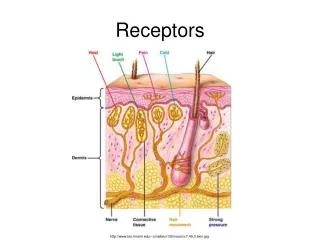
Sensorycells • Sensorycells are located in theretina. Thislayeriscomposed of differentneuronsadaptedtorecievedifferentintensity of light ordifferentcolors. (Rodes and cones) • Theneuronswillform a nerve, theopticnerve, tosendtheinformationtothebrain.
Hearing and balance • Vibrationsreachtheeardrum. Thenitistransmittedthroughthebones of themiddleear. Thisaction causes the fluid in theinnereartovibratestimulatingthecells of thecochlea, whichmake up theorgan of Corti. Thisorganismade up of neuronsthatform a nerve, theauditorynerve. • Thevestibulecontainsperilimphthatrunsinsidethethreechannels (semicircular channels) and twovesicles (utricule and sacule). Limphmovements determine the position alongwithvision and othermechanoreceptors.
Taste and smell Taste Smell Stimuli: chemicalsubstances in food Receptors: taste buds Place: mouth Stimuli: chemicalsubstances in air Receptors: olfactorycells in olfactorybulbs Place: nasal cavities 3000 differentsmells
Locomotion • Passiveparts: bones • Active parts: muscles • Bonesgivethebodystructure and support. • Muscles are attachedtobones, and move • them.
Bones • Bones are formedbytheossification of cartilage. Calciumisneededforstrongebonegrowth. • Functions: • Support • Shape • Protection • Attachmentsformuscles • Produce red bloodcells
Joints • There are threekinds of joint: fixed, movable, and semi-movable. • Fixedjointsstop thebonesfrommoving. Skul. • Movablejointsallowustomove. Theycontain a lubricatingliquid, calledsynovial fluid. Theyalsohaveligaments, whichkeepthebonesunited. Elbow. • Semi-movableallowonlylimitedmovements. Vertebrae.
Muscles • Muscles are made up of muscle-fibrebundles. Eachbundlecontainsmanylongelongatedmusclefibres. • Whentheyjoin up theprotectivecoveringsform a specialkind of tissuecalledtendons, whichconnect a muscleto a bone. • Musclescontractbybecomingshorter. Theenergyisobtainedfromcellularrespiration. • To produce thedesiredmovement, variousmusclesmustbecoordinated at thesame time. They are calledagonist, theyworkagainsothermusclescalledantagonists: onecontracts and theotherrelaxes.