Exploring the Kingdom Fungi: Structure, Reproduction, and Ecological Roles
80 likes | 211 Vues
This overview of the Kingdom Fungi delves into its eukaryotic structure, primarily multicellular forms, and the unique characteristics of unicellular yeasts. Fungi are heterotrophic decomposers that play a crucial role in breaking down dead organic matter, while also containing parasites that live off hosts. The structure comprises hyphae and mycelium, culminating in the visible fruiting body. Reproduction occurs through spores, which can spread easily. While fungi are essential for food production and soil formation, they can also lead to spoilage and diseases.


Exploring the Kingdom Fungi: Structure, Reproduction, and Ecological Roles
E N D
Presentation Transcript
Kingdom Fungi Unit 2 - Biodiversity
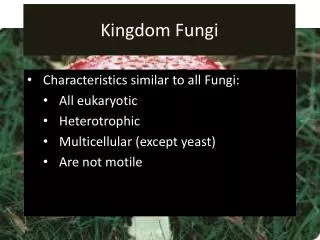
Kingdom Fungi • Eukaryotic • Mostly Multicellular • Yeasts are unicellular • Heterotrophic by absorption • Walls made of CHITIN • Decomposers • Live off dead or decaying matter • Parasites • Live off a living host
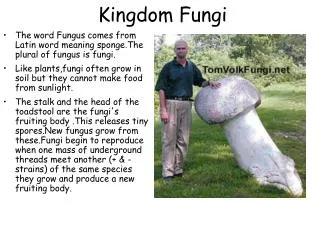
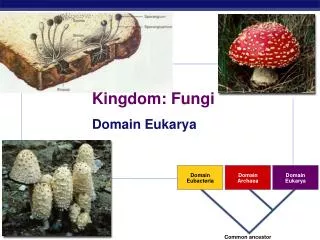
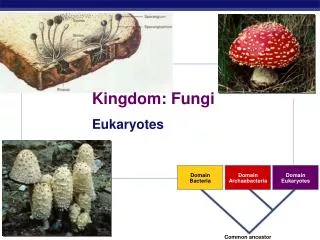
Structure of Fungi • Composed of hyphae • Branched filaments (groups of cells) surrounded by a hard chitin cell wall. • Makes up the body of the fungi • All except yeast, they are unicellular • Mycelium • Mass of hyphae, similar to the roots of a plant • The visible part of the fungus (both in mold and mushrooms) is called the fruiting body.
Structure Hyphae Whole Structure
How does fungi reproduce? • Reproduce by spores • Reproductive cells • Can reproduce both sexually and asexually • Held by the hyphae in a sporangia (spore case) • Where new spores land, new fungus will grow. • Think about how easily mold spreads on bread, or when you chop up a mushroom with the lawn mower and new mushrooms pop up. • Spores are spread by wind, water, animals, etc.
How do they eat? • Heterotrophic decomposers (some parasites). • Secrete digestive enzymes that decompose complex molecules into simple molecules like sugars and carbs. • Molds digestive carbs in things like bread • Mushrooms digest carbs and cellulose from the cell walls of wood and plant cells.
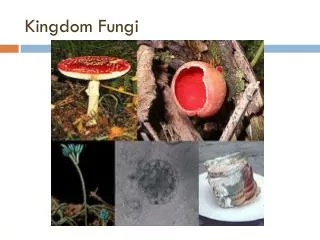
Fungi and you Positive Aspects of Fungi Negative Aspects of Fungi • Decomposers • Food (mushrooms, truffles, etc.) • Lichens grow on rocks and help produce soil • Yeasts are used in baking and brewing industry • Antibiotic Production • Food Spoilage • Diseases • athlete’s foot, ringworm, plant blight (American chestnut) • poisonous mushrooms