Comprehensive Review of Immune Response & Vaccination Strategies
This guide provides an in-depth exploration of crucial topics in immunology, including the mechanisms of effector T cells, humoral immunity, and innate immune responses, with a focus on Natural Killer (NK) cell activation and the role of cytokines in immune activation. It covers various vaccine types like inactivated, live attenuated, subunit, and conjugated vaccines, detailing their preparation, immunogenicity, and potential challenges. Selected materials from relevant chapters enhance understanding of adaptive immunity and its implications for protective immunization.

Comprehensive Review of Immune Response & Vaccination Strategies
E N D
Presentation Transcript
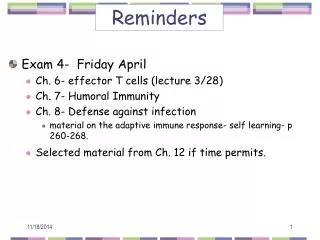
Reminders • Exam 4- Friday April • Ch. 6- effector T cells (lecture 3/28) • Ch. 7- Humoral Immunity • Ch. 8- Defense against infection • material on the adaptive immune response- self learning- p 260-268. • Selected material from Ch. 12 if time permits.
Killer Cell Ig Like Receptor (KIRs): Killer Lectin-like Receptors- Similar to C-type lectins/ not limited to carbohydrate binding.
LRC = leukocyte Receptor Complex NK cell Receptors are encoded in 2 gene complexes: • Chromosome 12= Natural Killer Complex (NKC). • Chromosome 19= KIR complex. • Alleles demonstrate polymorphism in the human population.
CD94/NKG2A Heterodimer- Binds HLA-E HLA-E functions as an indicator of the level of HLA-A, -B, & -C on the cell surface. Inhibitory Signals: • Various KIRs: • Specific for HLA-A,-B- & -C alleles. • > 50 discovered
Activating Receptors • Engage “abnormal” ligands: • Different glycosylation • Tumor Ag/viral glycoproteins • NKp46- binds heparan sulfate proteoglycans & viral proteins. • Engage stress induced ligands: • NKG2D
Mf: Supplies IL-12 early. TNF-alpha Dendritic cells & B cells- IL-12 IFN-a, b IL-12: NK cell proliferation Activation- Increased cytotoxicity Cytokines produced by macrophages, virally infected cells, & B cells activate NK cells.
Th1 cells produce cytokines that will drive CD8 + t cell & macrophage response A viral infection & the presence of IL-12 early will drive TH1 cell development
Vaccines Active Immunization
Development of an immune response does not necessarily mean that a state of protective immunity has been achieved. Must consider pathogens point of entry &/or growth site.
Types of vaccines: • A. Whole Organism Vaccines: 1. Inactivated vaccines: • Heat or Chemical- • Considerations: • Maintain antigenic determinants. • Viruses- nucleic acid must be inactivated. • Large amount of pathogen must be propagated. • Humoral immune response.
Whole organism vaccine continued: • 2. Live attenuated viral or bacterial vaccines: • Attenuated strains • Related pathogen that causes illness in other animal species: • Smallpox vaccine Vesicle formation on skin. TH2 response B cell & T cell memory.
Bacterial attenuation: • Vaccine for tuberculosis: • Mycobacterium bovis- cultured for >13 years on synthetic medium containing bile ----- BCG. • BCG- Bacille Calmette-Guerin.
Attenuated live vaccines demonstrate: • 1. Longer growth time in host: • Increased immunogenicity. • Increased memory cell response. • Cell Mediated Immune Response. • Example: Polio sabin vaccine- 3 attenuated viruses. • Replicated in intestinal epithelium. • IgA response + IgM + IgG. • 2. Generally does not require boosters.
3. Attenuated generally less stable than inactive. • 4. Concern for attenuated strain reversion & the presence of contaminants.
B. Subunit Vaccines- • Composed of purified macromolecules from the pathogen. • 1. polysaccharide vaccines- Capsules from bacteria. • 2. Toxoid Vaccines- • bacterial exotoxins- diphtheria / tetanus. • purified toxin is inactivated (formaldehyde).
A single isolated constituent of the microbial pathogen cannot alone provide an effective immune response. • Polysaccharides- • T- Independent type Antigen. • Stimulates B cells to produce IgM. • No isotype switching. • No affinity maturation. • No memory. • Proteins-
How can the subunit vaccine be made more useful? • Adjuvant addition to the macromolecule- • Tricks the immune system into thinking that it is under microbial attack. • Role for dendritic cells. • Role for cytokines. • Conjugated Vaccines: Ag is conjugated to a carrier, usually protein. • Converts a T- independent antigenic response into a T dependent antigenic response.
Current Vaccine development: • 1. Use of attenuated microbes as vaccine vehicles for recombinant antigens. • Requires attenuated strain. • Requires knowledge of genes responsible for virulence & immunity. • Requires Biotechnology.
Plasmid DNA containing the gene encoding for a pathogens surface protein. Muscle cells + dendritic cells take in DNA and express the gene. DNA vaccines: Inject intramuscularly